Zero Trust Assessment: What It Actually Covers and Why Your Azure Migration Depends on It
June 19, 2026
Depending on which tech vendor’s brochure you happen to be reading, Zero Trust is described alternately as a philosophical breakthrough, a singular software platform, or a mandatory compliance buzzword. If you are an IT director or a business leader tasked with maintaining an enterprise defense system, this marketing noise makes it incredibly difficult to understand exactly what you are paying for—and how it actually keeps your company from ending up in a security headline.
Let’s strip away the sales pitches. A zero trust assessment is not a product demonstration or a generic security checklist. It is a rigorous, deeply technical evaluation of your actual operational infrastructure.
At Cocha Technology, we guide organizations through this process every month. We’ve discovered that establishing a verified framework isn’t just an excellent way to secure your daily operations; it is an absolute prerequisite for a successful, secure cloud transition. If you are moving data or infrastructure without running these checks first, your upcoming cloud migration is sitting on highly unstable ground.
What Zero Trust Architecture Actually Means (Without the Marketing)
To understand why a structured evaluation is so critical, we have to look past the catchphrases and look at the fundamental shift in how networks operate. The core directive of a modern zero trust architecture is exceptionally simple: Never trust, always verify.

In the early days of corporate IT, we relied on a “castle-and-moat” security design. We built a strong perimeter firewall around the corporate office. If a user or a server sat inside that building, the network trusted them by default.
But out here in the real world, that model is entirely dead. Thanks to remote work, mobile endpoints, and distributed SaaS applications, your corporate assets live everywhere. Furthermore, modern cloud workloads and security agents operate deep inside your environments by default. If an attacker manages to compromise a single endpoint inside a traditional network, they can move horizontally wherever they want because the internal structure trusts them blindly.
A true zero-trust design treats every single access request as a potential threat, regardless of where it originates. It requires continuous, real-time verification of identity, device health, and situational context, enforcing strict boundaries around your files and databases. According to the foundational NIST Special Publication 800-207 on Zero Trust Architecture, this framework is designed to eliminate implicit trust zones entirely, preventing lateral movement across your systems.
What a Professional Zero Trust Assessment Covers
When we conduct an evaluation at Cocha Technology, we aren’t scanning your environment to tell you which security software to buy. We are looking at how your data, identities, and networks interact.
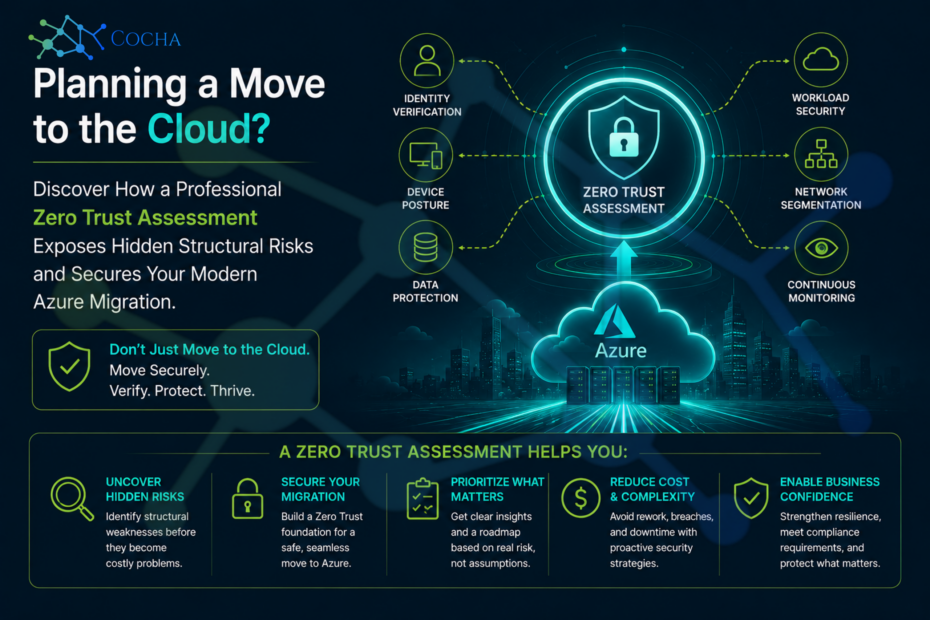
The evaluation evaluates your current infrastructure configuration against five distinct, measurable pillars to highlight your exact structural vulnerabilities.
1. Identity Verification and Entra ID Health
Identity is the new perimeter. We look closely at how your users and background service accounts authenticate.
- What we evaluate: We check whether Multi-Factor Authentication (MFA) is comprehensively enforced across every user profile, how your privileged admin roles are managed, and whether your Microsoft Entra ID settings are configured to identify risky sign-in behaviors.
- The Exposure Gap: If legacy authentication pathways remain unmonitored, bad actors can easily run automated password-spraying scripts to bypass your modern identity rules entirely.
2. Device Compliance and Endpoint Health Check
An identity is only as secure as the laptop or phone hosting it. If a user with perfect credentials logs in from a malware-infected machine, your data is compromised.
- What we evaluate: We audit whether your endpoints meet a strict health baseline—such as verifying that disk encryption is active and operating systems are patched—before they are granted entry to critical environments.
- The Exposure Gap: Without strong conditional access rules, an employee’s teenager could download a malicious file on a shared home computer, giving attackers an immediate backdoor into your corporate drive.
3. Least Privilege Enforcement
This control ensures that your personnel have the exact amount of access required to complete their daily jobs, and absolutely nothing more.
- What we evaluate: We map out user permissions to identify “permission creep,” where staff members accumulate administrative access to old folders or legacy databases over several years.
- The Exposure Gap: When a regular user account holds high-level contributor rights, a basic phishing compromise can instantly turn into an organizational crisis as the attacker inherits those sweeping administrative capabilities.
4. Micro-Segmentation and Network Isolation
Traditional networks are entirely flat. Once an outsider gets past the perimeter firewall, they can access everything from your cafeteria menu to your primary financial ledger.
- What we evaluate: We audit your virtual networks to ensure your development, staging, and production environments are fully isolated from one another through micro-segmentation.
- The Exposure Gap: A flat network layout allows an attacker who compromises a non-critical testing virtual machine to pivot easily across internal lines, gaining unrestricted access to your live customer records.
5. Continuous Monitoring and Real-Time Alerting
You cannot respond to an active threat if your engineering team is completely blind to anomalous system behavior.
- What we evaluate: We verify that your diagnostic settings are actively enabled across your entire environment and that your activity logs are flowing directly into an actionable security platform.
- The Exposure Gap: Without centralized logging, an unauthorized user could spend months quietly copying sensitive client data without triggering a single automated alarm or notification.
The final output of this process is a highly detailed, scored gap list. We give you a clear technical baseline showing exactly where your configuration is thinnest, providing a strategic plan for your next engineering steps.
Why Your Azure Migration Depends on Zero Trust First
An incredibly common mistake Steve and I see teams make is rushing directly into a cloud migration to hit a strict corporate deadline, assuming they will sort out their security posture once everything is live in the cloud. This approach is an invitation for disaster.
Microsoft Azure is an exceptionally secure foundation, but it is built on a shared responsibility model. Azure assumes you have a modern security framework in place; it will not enforce those controls for you by default. If you migrate an environment built on overprivileged user accounts, flat networks, and messy folder permissions into the cloud, you are simply magnifying your vulnerabilities on a global stage.
The common infrastructure oversights we detailed in our recent deep dives regarding cloud infrastructure misconfigurations and pre-migration security scans are fundamentally zero-trust failures. If your framework doesn’t explicitly verify identities and isolate resources, you will fall victim to a costly cloud security misconfiguration the moment your workloads hit the public web.
By prioritizing a proactive security review, you stop these errors before they can happen. You ensure your destination tenant is pre-hardened to receive your virtual workloads, eliminating costly remediation projects after the cutover. For teams deploying advanced endpoint monitoring, this aligns directly with our proven zero-trust agent deployment methodologies, keeping your assets secure from day one.
What a Zero Trust Assessment Does Not Cover
To build genuine, transparent partnerships with technical buyers, it is essential to be perfectly clear about what this evaluation is not. This process is a targeted configuration review, not a universal catch-all security service.
- It Is Not a Penetration Test: A pen test is an active, point-in-time ethical hacking exercise where a consultant tries to break into your network using exploits. A zero-trust evaluation is a structural blueprint audit. We look at the architecture of your house to tell you if the doors are unlocked; we aren’t throwing bricks at your windows.
- It Is Not a Generic Compliance Audit: A compliance audit is designed to generate a trailing report for a regulatory board. This assessment is a forward-looking, highly practical engineering review built to guide your active operations.
- It Is Not a Software Deployment: We aren’t here to install a proprietary software suite or force you into an expensive vendor ecosystem. We look closely at how to configure your existing cloud investments correctly, keeping your digital footprint lean, efficient, and exceptionally resilient.
Establish Your Security Benchmark
A successful move to the cloud should represent an incredible milestone for your operational efficiency, not a new point of vulnerability for your corporate data assets. By building your migration strategy on a comprehensive zero trust assessment, you eliminate structural guesswork and ensure your new cloud footprint is genuinely locked down against modern threats.
Stop wondering if your current system rules are keeping your business safe. Let Steve and the engineering team at Cocha Technology evaluate your environment, expose the quiet gaps, and help you construct a clean, high-performance foundation for your upcoming migration goals.
Evaluate Your Infrastructure Safety
Don’t wait for an active data leak to show you where your configuration rules are failing. Contact us today to schedule your professional Zero Trust Assessment and build a secure foundation for your move to Azure.
Recent Posts
Have Any Question?
Call or email Cocha. We can help with your cybersecurity needs!
- (281) 607-0616
- info@cochatechnology.com
About the Author:

Steve Combs
Co-Founder & Managing Director, Cocha Technology
Steven is a fractional CIO/CISO with 30+ years of enterprise IT and security leadership. He has built AI governance frameworks for organizations with 1,700+ users, led enterprise Microsoft Copilot deployments, and conducted security assessments across law firms, energy companies, financial institutions, and PE-backed manufacturers.