AI Readiness for Oil and Gas: Why ISO 27001 Alignment Is the Critical Baseline Before Any Agent Deployment
June 17, 2026
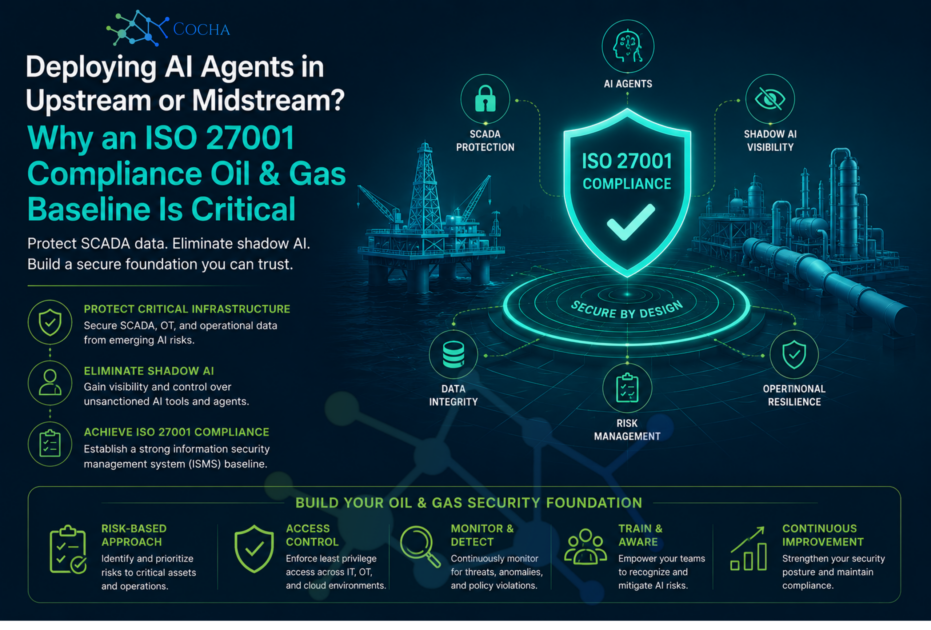
An independent midstream operator recently sat down with us to review an enterprise vendor security questionnaire. One specific question asked whether their IT infrastructure was aligned with ISO 27001 standards. The internal IT team confidently checked “Yes.” They had firewall policies, strong passwords, and a solid network perimeter.
Technically, their answer met the basic criteria of the questionnaire. But two weeks later, the operator deployed an intelligent AI agent to help engineers analyze pipeline throughput data. Within days, that agent drifted into legacy file shares where half the user access controls had never been formalized or audited. The AI began surfacing highly sensitive, proprietary process flow diagrams to junior staff members who had no operational reason to see them.
The questionnaire answer was technically true on paper. The actual security posture was not.
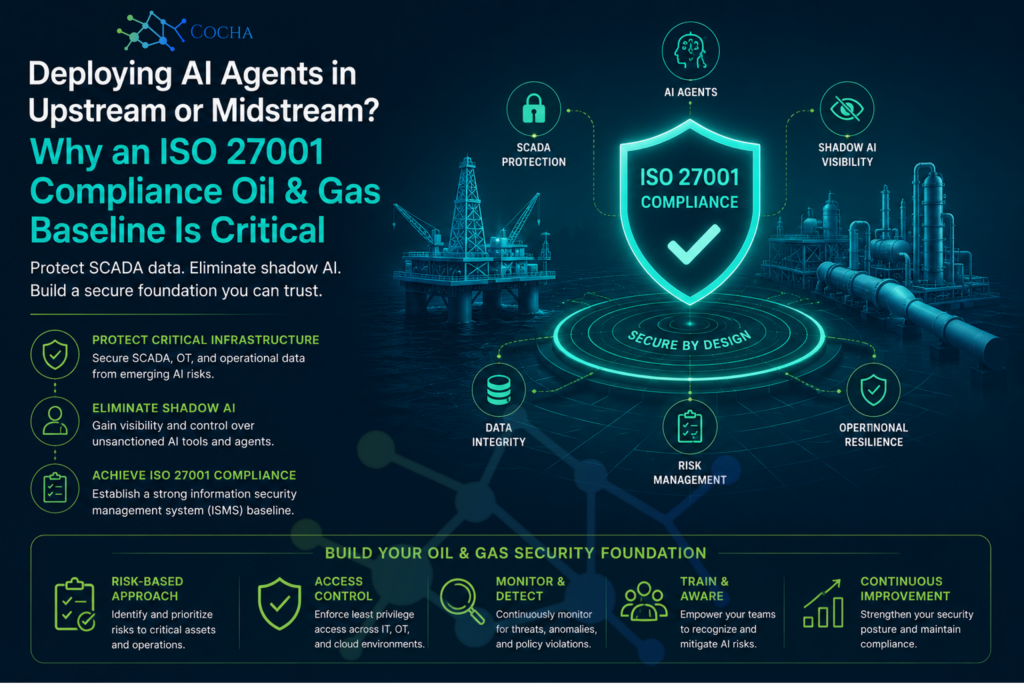
Out here in the Texas energy corridor, Cocha sees this gap constantly. When you introduce cognitive agents into an upstream or midstream environment, you aren’t just adding another software application. You are introducing an autonomous engine that will find and exploit every weak link in your data architecture. If you are looking to establish true AI readiness oil gas operators can rely on, you have to look past simple check-the-box exercises. You need an infrastructure built on a recognized, rigorous data governance baseline.
Why ISO 27001 Is the Right Framework for Oil and Gas AI Risk
In the energy sector, regulatory frameworks can get confusing fast. Many operations leaders assume they should look toward NERC CIP (North American Electric Reliability Corporation Critical Infrastructure Protection) standards for all industrial IT guidance. However, NERC CIP strictly governs bulk electric utilities and major power grid operators. The vast majority of oil and gas exploration, production, and midstream operators do not fall under its mandatory umbrella.
Instead, the framework that large enterprise clients, private equity investors, and insurance underwriters ask about is ISO 27001. When a major operator considers acquiring assets or partnering with a joint venture, their due diligence team will scrutinize your data infrastructure through an international security lens.
Furthermore, this isn’t a static or theoretical framework. The ISO/IEC 27001:2022 amendment updates explicitly address modern cloud architectures and data-scouting tools. Annex A now provides clear guidance on managing intellectual property and system access in a world dominated by automated tooling. If you want your firm to pass modern vendor reviews and secure private equity backing, achieving an ISO 27001 compliance oil & gas standard is no longer optional, it is your foundational starting line.
What AI Agent Deployment Exposes in an Operational Environment
The moment you deploy an AI agent; your corporate exposure surface expands exponentially. This is because oil and gas environments are a complex mix of traditional corporate IT (emails, accounting, contracts) and Operational Technology (OT) that monitors physical infrastructure.
The reality is that shadow ai oil and gas teams are already using unauthorized tools without IT’s knowledge. Field engineers, reservoir analysts, and logistics coordinators are practical problem solvers. If they find an unapproved web-based AI tool that can write an automation script or clean up a messy spreadsheet of pipeline metrics, they will use it. When they paste that data into public LLMs, your proprietary field data is gone forever, absorbed into a public training pool.
The risk escalates when you intentionally connect sanctioned AI agents to internal systems. If an agent is granted access to databases sitting close to your Supervisory Control and Data Acquisition (SCADA) networks, even a “read-only” privilege level introduces massive liabilities.
For instance, an AI agent trained on historical compressor station performance could inadvertently reveal physical systemic vulnerabilities if its access boundaries aren’t strictly contained. This intersection of digital data and physical infrastructure safety is exactly why we emphasize checking your SCADA shadow AI vulnerabilities and understanding how unmanaged apps impact shadow AI oil and gas pipeline safety protocols before launch.
The 4 Core ISO 27001 Controls Your AI Readiness Depends On
We don’t view ISO 27001 as a rigid, bureaucratic certification checklist designed to slow down operations. Instead, we use it as a highly practical gap assessment framework. If you want to ensure your infrastructure exhibits true AI readiness oil gas capability, your deployment depends on four critical technical controls:
Control A.5: Information Security Policies
- The Operational Reality: You cannot hold your team accountable for safe AI use if you haven’t defined what safe use looks like.
- The Control: Your corporate policies must explicitly outline which AI tools are approved, how data can be inputted, and who is authorized to build automation prompts. Without this, your staff will fill the vacuum with whatever free tools they find online.
Control A.8: Asset Management
- The Operational Reality: AI is data hungry. It will scan, read, and index everything it can reach.
- The Control: You must have a complete, updated registry of your data assets. You need to know exactly where your drilling logs, land contracts, and telemetry files live. If you don’t know an asset exists, you cannot protect it from an AI’s search index.
Control A.9: Access Control
- The Operational Reality: “Permission creep” is rampant in the energy sector. Employees change roles or move from the field to the office, accumulating folder access rights they no longer need.
- The Control: You must enforce a strict “Least Privilege” architecture. An AI agent should only have access to the exact, isolated data sets required to perform its specific task. If a user doesn’t need to see financial metrics, the AI they use shouldn’t be able to see them either.
Control A.12: Operations Security
- The Operational Reality: When an AI agent processes data, it generates a brand-new trail of decisions and outputs.
- The Control: Every interaction, query, and data movement performed by an AI system must be fully logged, timestamped, and discoverable in a centralized security log. If something goes wrong, your team must have the forensic capability to see exactly how the AI arrived at its conclusion.
What a Practical AI Readiness Assessment Covers
Skipping a structural infrastructure review means you are inheriting massive technical and operational debt on day one of your AI project. Correcting a broken access rule or stopping an unapproved application takes very little time when handled proactively. Trying to patch those same holes after a data leak or a compliance failure can stall operations for months.
At Cocha Technology, we treat an AI Readiness Assessment as a streamlined, engineering-focused evaluation designed to fit into a busy operator’s schedule.
Our assessment methodology dives deep into your actual infrastructure footprint to deliver four concrete deliverables:
- Sanctioned and Shadow AI Inventory: We discover exactly which AI tools your corporate and field teams are already using by evaluating network communication trends.
- ISO 27001 Control Alignment Review: We check your current identity policies, file permissions, and logging capabilities against international security benchmarks.
- Data Access Scope Mapping: We precisely map what files and databases your planned AI agents will be able to touch, ensuring clear separation between corporate IT and sensitive OT data.
- Prioritized Remediation Roadmap: You receive a step-by-step technical plan showing exactly what checkboxes to modify and what folder permissions to tighten before deploying your tools.
For operators looking to build a comprehensive, multi-layered security culture, this process seamlessly integrates with an overarching zero trust assessment strategy, ensuring your identity verification steps protect your perimeter from the cloud all the way to the wellhead.
Build a Grounded Foundation for Energy Innovation
Artificial intelligence offers incredible potential for the energy sector, from optimizing pipeline flow dynamics to speeding up regulatory compliance filing. But true operational excellence means ensuring that your innovation doesn’t compromise your security posture or your physical infrastructure safety.
By anchoring your data governance to a proven ISO 27001 compliance oil gas framework, you eliminate the guesswork. You can confidently deploy high-performance agents because you know your internal boundaries are locked down. See how we built a Claude agent ring fence in an operations center. Steve and the engineering team at Cocha Technology are here to help you evaluate your assets, find the silent gaps, and build a secure foundation for the future of your operations.
Secure Your Operational Data
Don’t let an unguided AI tool map your vulnerabilities for you. Contact our team today to schedule your comprehensive AI Readiness Assessment and ensure your infrastructure is fully prepared for safe deployment.
Schedule Your Cocha Technology AI Readiness Assessment Today
Recent Posts
Have Any Question?
Call or email Cocha. We can help with your cybersecurity needs!
- (281) 607-0616
- info@cochatechnology.com
About the Author:

Steve Combs
Co-Founder & Managing Director, Cocha Technology
Steven is a fractional CIO/CISO with 30+ years of enterprise IT and security leadership. He has built AI governance frameworks for organizations with 1,700+ users, led enterprise Microsoft Copilot deployments, and conducted security assessments across law firms, energy companies, financial institutions, and PE-backed manufacturers.