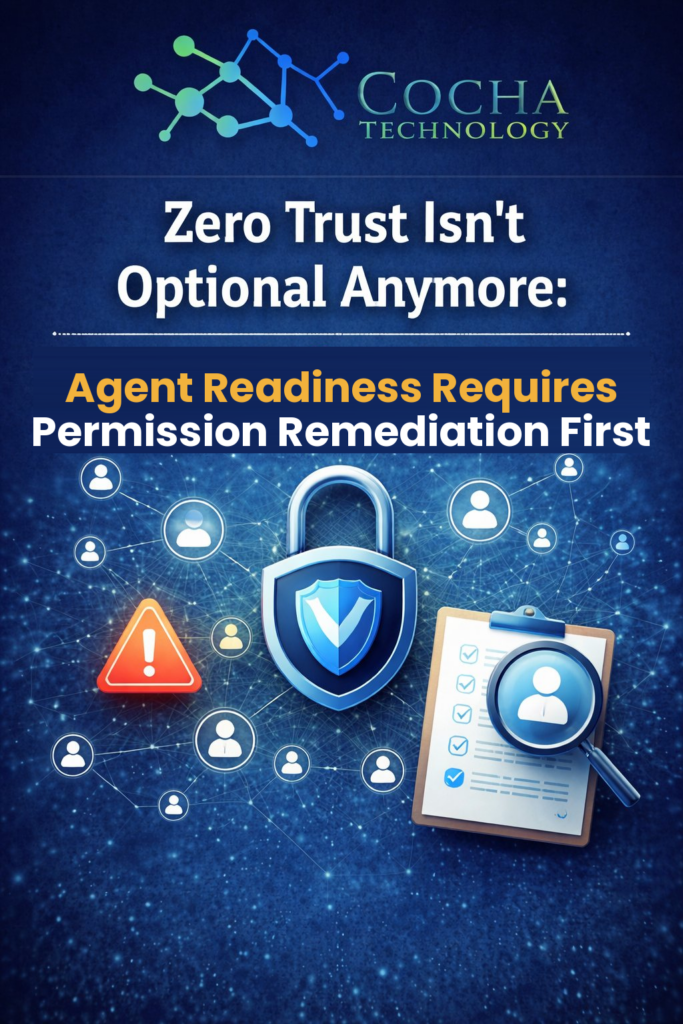
Zero Trust Isn’t Optional Anymore: Agent Readiness Requires Permission Remediation First
April 15, 2026
You can build the most carefully configured agent in the world. You can scope its instructions precisely, test its responses thoroughly, and document its design with the rigor of a regulated system. And then you deploy it into your infrastructure — and it inherits every permission gap that has been accumulating in your environment for the past five years.
Zero trust is the principle that no user, no device, and no application should be trusted by default. Every access request gets verified. Every privilege gets scoped to exactly what is needed. Trust is never assumed; it is continuously earned.
Most organizations believe in this principle. Most have not implemented it. And most did not feel the urgency of that gap until agents entered their environment.
Agents change the calculus entirely. They do not browse your files the way a human does — selectively, with judgment, constrained by time and attention. They read everything they have permission to read, systematically, as part of their normal operation. Every overprivileged account becomes an agent attack surface. Every forgotten shared folder becomes an agent data source. Every broken permission inheritance becomes an agent pathway.
Zero trust is not optional for organizations deploying agents. It is the foundation. And the only way to build that foundation is to start with a clear picture of where you stand today.
Why Zero Trust Matters Specifically for Agents
Traditional cybersecurity thinking focuses on the perimeter — keeping external threats outside the network. Zero trust starts from the assumption that the perimeter has already been breached, or will be, and that security must therefore be enforced at every individual access point rather than at the edge of the network.
This reframing is important because agents are, in the most precise technical sense, insider threats. Not malicious — but operating from inside the network, with inside credentials, accessing inside data. The threat model is not “external attacker breaks in.” It is “internal system with broad permissions is misconfigured, compromised, or simply does what it was designed to do with data it should never have reached.”
Zero trust was designed for exactly this threat model.
The specific mechanisms through which agents create zero trust risk fall into three categories.
First, agents scale access in ways humans cannot. A senior attorney at a law firm has access to dozens of client matters but engages deeply with only a few at any given time. An agent operating with that attorney’s permissions has access to all of those matters simultaneously and processes all of them as part of building its contextual model. The scope of access that a human uses partially becomes the scope of access an agent uses fully.
Second, agents do not exercise judgment about sensitivity. A human employee with access to a confidential compensation file rarely opens it unless they have a reason to. An agent with the same access will index that file as part of its normal operation, because it has no mechanism to distinguish between data it should engage with and data it should ignore. All data within its permission scope is equally accessible.
Third, agents can be redirected. Prompt injection — where malicious content embedded in a document or website instructs an agent to take specific actions — is a real and documented attack vector. If your agent is compromised through prompt injection and it has overprivileged access, the scope of potential damage scales with the scope of that access. A well-implemented zero trust architecture limits the blast radius.
The Permission Remediation Challenge
The gap between where most organizations are and where zero trust requires them to be is larger than most IT leaders realize — not because their intentions were wrong but because permission management is a slow, accumulative problem that tends to get deferred.
Here is how overprivilege typically develops in a Microsoft 365 environment.
An employee joins the organization and is granted access to the systems they need. Over their tenure, they change roles, join project teams, get added to shared sites, and accumulate access. When they move to a new role, some of their old access gets removed. But not all of it, because removing access requires knowing what they had and deciding what they no longer need — a process that is time-consuming and easy to skip.
A project team creates a SharePoint site for a confidential initiative. When the project ends, the site remains active because nobody owns the decommissioning process. Users who were on the project team still have access because their permissions were never revoked. The site contains documents that are now stale but still sensitive.
An IT administrator creates a shared service account with broad permissions to handle a specific integration. The integration changes over time. The service account permissions are never updated to reflect the reduced scope of its current role.
Multiply these patterns across an organization of 200, 500, or 2,000 users, and the result is a permission landscape that is far more permissive than any security policy intended — and far more permissive than an agent should be allowed to inherit.
Only 1% of organizations currently meet the full definition of zero trust security, according to research from PacketLabs. This is not because organizations have abandoned the principle. It is because permission remediation at scale is hard, time-consuming, and organizationally complex. It requires knowing who has access to what, deciding who should have access to what, and then managing the change process without disrupting operations.
Agents make this work urgent. Before agents, overprivileged access was a security risk in theory. After agents, it is a security risk in practice — because agents will use every bit of access they inherit.
"Before agents, overprivileged access was a security risk in theory. After agents, it is a security risk in practice — because agents will use every bit of access they inherit."
What a Zero Trust Assessment Uncovers
Our zero trust assessment is not an abstract architectural review. It is a concrete audit of your current permission state, your identity verification posture, your monitoring capabilities, and your remediation priorities.
The assessment starts with your permission baseline. How many accounts in your environment have privileged access? How is that access distributed? What are the highest concentrations of risk — the accounts, shared sites, or service identities that represent the most dangerous agent attack surfaces?
It continues with over-privilege analysis. Which accounts have permissions beyond what their current role requires? Which shared service accounts have administrative rights that were never scoped down? Which former project sites still have active user access?
Identity verification is the third component. Are your administrative accounts protected by multi-factor authentication? What is your conditional access policy coverage? Do your service accounts — the accounts agents often operate through — have the same identity verification requirements as human accounts?
Monitoring and audit trail coverage is the fourth element. If an agent were compromised tomorrow and began accessing data beyond its intended scope, would your current logging capture what it accessed? In most organizations, the honest answer is no. Agent activity leaves a thin audit trail compared to human activity, and most logging configurations were not designed with agent forensics in mind.
Network segmentation — whether your infrastructure isolates sensitive resources or allows agents to pivot freely between systems — rounds out the core assessment.
Optional but valuable: for organizations using Microsoft Entra ID, we can deploy CISA assessment tooling to get live data on your actual identity posture rather than relying on policy documentation. This gives you objective evidence rather than self-assessment, and the tooling is read-only and leaves no persistent footprint.
Your agents will inherit every permission gap you have. Find out what they would inherit.
Building Your Zero Trust Foundation
Zero trust is an architecture, not a product. You cannot buy it. You build it — incrementally, starting from a clear understanding of your current state and working systematically toward least-privilege access, continuous verification, and full audit trail coverage.
The sequence matters. Organizations that try to implement zero trust controls before they understand their current permission state often find that the controls do not hold — because the underlying permission structure is more complex than the policies they are trying to enforce.
Start with visibility. Map your actual permission state. Know who has access to what, not according to what your policies say but according to what the data shows.
Move to remediation. Deprovision stale access. Scope service accounts down to the minimum permissions their function requires. Rebuild broken permission inheritance. This is the unglamorous work — it is also the work that makes everything else effective.
Then implement controls designed for agents. Permission scoping that limits agent access to specific data sets rather than all data the user can access. Monitoring configured to capture agent activity. Conditional access policies that treat agent authentication differently from human authentication.
Agents are not going away. Organizations that build this foundation will be able to deploy agents that deliver real value — faster, more capable, and safer than their competitors. The assessment is step one.
Zero trust is not a project you get to eventually. It is the prerequisite for deploying agents that do not create unacceptable risk. The gap between where most organizations are and where they need to be is real — but it is measurable, and it is fixable if you start with a clear picture of where you stand.
Cocha’s Zero Trust Assessment gives you that picture. Ninety minutes, optional CISA tooling for live Entra data, findings in three to five business days, and a prioritized six-month remediation roadmap.
Schedule your free Zero Trust Assessment. Know exactly what your agents would inherit — before they inherit it.
Recent Posts
Have Any Question?
Call or email Cocha. We can help with your cybersecurity needs!
- (281) 607-0616
- info@cochatechnology.com
About the Author:

Steve Combs
Co-Founder & Managing Director, Cocha Technology
Steven is a fractional CIO/CISO with 30+ years of enterprise IT and security leadership. He has built AI governance frameworks for organizations with 1,700+ users, led enterprise Microsoft Copilot deployments, and conducted security assessments across law firms, energy companies, financial institutions, and PE-backed manufacturers.