Cloud Misconfigurations and Agents: Why Your Infrastructure Is Ready for Breach, Not Automation
April 17, 2026
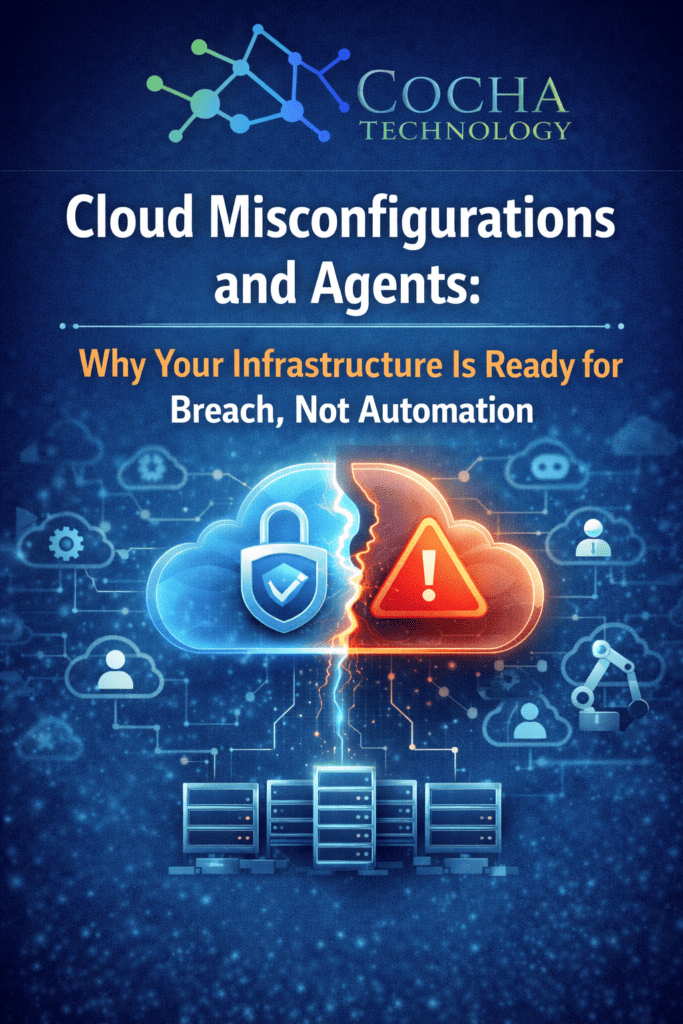
Your cloud infrastructure is misconfigured. This is not speculation — it is the baseline reality for the overwhelming majority of organizations that have migrated workloads to Azure, AWS, or GCP over the past decade. Misconfigurations are not failures of intent. They are the natural accumulation of rapid deployment decisions, evolving architectures, legacy integrations, and the gap between what cloud security requires and what resource-constrained IT teams have time to maintain.
Before agents, these misconfigurations were serious but survivable. Human employees rarely stumble across a public Azure storage blob that was left accessible by mistake. They do not methodically check every cloud resource for configuration gaps. They are busy, distracted, and focused on their actual work.
Agents are none of those things.
An agent with access to your cloud environment — through an integration, through inherited permissions, or through a service account — will find your misconfigurations. Not maliciously. It will find them because it accesses every resource it has permission to access and uses that data to generate responses. A publicly readable storage account is just another data source. An overprivileged service account is just another set of credentials.
The question is not whether your cloud has misconfigurations. The question is whether your agents will find them before your security team does.
How Agents Exploit Cloud Gaps
Cloud misconfigurations fall into a consistent set of categories: storage resources with overly permissive access, service accounts with more privileges than their function requires, unencrypted data in rest and transit, administrative accounts without multi-factor authentication, insufficient logging, and flat networks that allow lateral movement between resources.
Humans rarely exploit these gaps, not because they cannot but because they have no reason to go looking. A developer who creates an Azure storage account with public read access for a temporary project does not advertise that to colleagues. Nobody else in the organization is actively scanning for misconfigured storage. The exposure sits dormant.
Agents change this dynamic in two ways.
First, agents with access to your cloud configuration or inventory — through Azure Resource Manager APIs, through cloud management integrations, or through documentation stored in SharePoint — can map your infrastructure quickly and systematically. An agent helping an engineer troubleshoot a deployment issue might pull from infrastructure documentation that describes storage account configurations, service account permissions, or network architecture. That information is now part of the agent’s context.
Second, agents can be redirected to exploit gaps they find. Prompt injection attacks — where malicious content in a document, email, or web page instructs an agent to take specific actions — are documented and increasingly sophisticated. If an attacker knows your organization uses agents and suspects there are misconfigured cloud resources, they can craft content designed to instruct your agent to access and exfiltrate data through a known misconfiguration.
This is not theoretical. Security researchers have demonstrated prompt injection attacks against deployed agents across multiple enterprise platforms. The attack surface is your cloud infrastructure; the vector is your agent.
The Six Misconfigurations Agents Find First
- Public cloud storage buckets or blobs:
Azure Blob Storage, AWS S3, and GCP Cloud Storage all allow administrators to set individual resource access to public. This is legitimate for specific use cases — hosting static website assets, sharing public-facing files. It is a serious problem when applied to resources that contain operational data, backups, customer records, development files, or configuration data.
Agents with access to storage account documentation or with direct integration into cloud storage will access public resources without restriction. They have no mechanism to recognize that a resource was made public accidentally rather than intentionally.
- Overprivileged service accounts:
Service accounts — non-human identities used by applications, integrations, and automated processes — accumulate permissions over time in the same way human accounts do. An account created to handle a specific integration often ends up with administrative rights far beyond its function because scoping permissions down requires effort that is easy to defer.
Agents frequently operate through service accounts. An overprivileged service account gives the agent access to resources far beyond its intended scope — and unlike a human operating through the same account, the agent will access all of it. - Unencrypted data in rest and transit:
Cloud resources that store sensitive data without encryption at rest, or that transmit data without encryption in transit, expose that data to any process that can reach the resource. Agents that access unencrypted data have access to everything in it — there is no technical barrier between the agent and the data’s contents. - Missing multi-factor authentication on administrative accounts:
Administrative cloud accounts protected only by a username and password are a single compromise away from total access. If an agent is operating through a compromised administrative account — or if an agent account itself lacks MFA — the access available to that agent covers your entire cloud environment. - Logging and monitoring gaps:
Most cloud environments have logging capabilities that are not fully enabled. Logging every API call, every storage access, every authentication event generates data volume and cost. Organizations make tradeoffs. The result is gaps in the audit trail — periods where agent activity cannot be reconstructed after the fact.
If your agent is compromised or misconfigured and you need to know what it accessed, incomplete logging makes that reconstruction impossible. Regulatory and compliance frameworks increasingly require complete audit trails, specifically including AI system activity. - Flat network architecture:
In a flat network, all resources can communicate with all other resources. There is no segmentation between your production environment, your development environment, your sensitive data stores, and your operational systems. An agent with access to any point in a flat network can potentially reach any other point.
Agents built on least-privilege access in a segmented network are contained when compromised. Agents operating in flat networks are not.
"A misconfigured storage account that nobody has noticed in two years will be found by an agent in the first hour of operation. Agents are thorough in ways humans simply are not."
What Your Cloud Security Assessment Should Cover
A cloud security assessment for organizations deploying agents is not just about finding misconfigurations. It is about understanding your cloud environment through the lens of what an agent would access, what gaps it would find, and what damage a compromised agent could do.
The assessment covers six areas.
Storage access controls — which storage resources are public or overly permissive, and what data do they contain.
Service account privilege audit — which service accounts have permissions beyond their current function, and which agents operate through them.
Encryption posture — which resources store or transmit sensitive data without encryption.
Authentication controls — MFA coverage across administrative accounts and service identities.
Logging and monitoring baseline — what your current logging captures, what it misses, and whether you could reconstruct agent activity after the fact.
Network segmentation — whether your infrastructure contains blast radius limiting between systems, or whether lateral movement is possible.
Each finding is assessed not just as a general security risk but specifically in the context of agent access: what would an agent with this misconfiguration in scope be able to reach, and what would happen if that agent were compromised.
Your cloud infrastructure probably has misconfigurations your agents will find before your security team does.
Agents Work Better on Solid Infrastructure
The purpose of a cloud security assessment is not to slow down your agent deployment. It is to make your agent deployment safe — and by extension, durable. Agents built on misconfigured infrastructure fail in unpredictable ways. Agents built on solid infrastructure deliver consistent, controlled, auditable results.
A well-configured cloud environment gives your agents clear data boundaries — they know what they can access because the infrastructure enforces those boundaries rather than relying on the agent to self-limit. It gives you full audit trails — you can see exactly what your agent accessed, when, and why. It gives you blast radius protection — if something goes wrong, the scope of the problem is contained.
Organizations that assess their cloud infrastructure before deploying agents do not just reduce their risk. They build agents that work better and are easier to govern over time.
Cloud misconfigurations are universal. Agents that find them are increasingly common. The combination creates a risk profile that grows more dangerous as agent capability expands.
The cloud security assessment maps your specific exposure — your storage configurations, your service account privileges, your encryption posture, your monitoring gaps — through the specific lens of what an agent would access and what happens if that agent is compromised.
Schedule your free assessment. Understand your infrastructure the way your agents will understand it — before they do.
Recent Posts
Have Any Question?
Call or email Cocha. We can help with your cybersecurity needs!
- (281) 607-0616
- info@cochatechnology.com
About the Author:

Steve Combs
Co-Founder & Managing Director, Cocha Technology
Steven is a fractional CIO/CISO with 30+ years of enterprise IT and security leadership. He has built AI governance frameworks for organizations with 1,700+ users, led enterprise Microsoft Copilot deployments, and conducted security assessments across law firms, energy companies, financial institutions, and PE-backed manufacturers.