

AI Risk Mitigation for Law Firms: Google’s Legal AI Pitch
September 23, 2026
Google Just Entered the Legal AI Race. Here Is What Its Governance Pitch Really Covers.
Google spent August walking into the legal AI market and September explaining why it thinks the entrance is about governance. A general counsel told a room full of reporters that AI cannot be the final decision maker in a courtroom. Meanwhile, a public count of AI hallucinated citations in court filings crossed 2,000 documented cases worldwide this month.
Hold those two facts together and you get the real story: legal AI is no longer a question of whether your firm adopts it. It is a question of whether your firm can point at controls that show how it gets used, by whom, and against what data. That question is where AI risk mitigation for law firms starts. Not with a model. With a map of your own house.
A note before going further: nothing here is a pitch against Google. Their pitch is good. The problem is what most firms will hear from it, because the part firms skip is the part that decides the outcome.
A Deep Pocketed Entrant Changes the Conversation
On August 25th Google announced Gemini Enterprise for Legal, the first of its packaged industry solutions built on top of the Gemini Enterprise platform. The description is specific: out of the box domain capabilities, tailored agents, specialized skills, and prebuilt connectors into the tools a legal team already works in. Named firms got early access to shape the platform.
That lands squarely in the Harvey and CoCounsel conversation. Until now the legal AI market had a familiar shape. A handful of well-funded, focused vendors sold into sophisticated firms, and the rest of us watched procurement teams work out pricing with little competitive pressure. A platform company of Google’s size entering the category changes two things at once. Expectation of a governed control plane becomes table stakes, which helps buyers. And the sales calls get more confusing, which does not.
It is also worth saying what this means for midmarket firms. The governance language that Google and its competitors now lead with used to be reserved for AmLaw-scale procurement conversations. When a vendor of this size standardizes “secure, fully governed” messaging, firms with 30 or 80 lawyers start hearing the same pitch and, reasonably, start asking the same auditors the same questions. Client security questionnaires pick up vendor marketing vocabulary faster than almost anything else in this space.
The Timing Is Hard to Ignore: 2,000 Documented Hallucination Cases
A public research project, the AI Hallucination Cases Database maintained by legal researcher Damien Charlotin, tracks court decisions where generative AI produced hallucinated content. Fake citations, mostly, but also invented arguments and fabricated quotations. Reporting on the database this month put the worldwide count past 2,000 cases, with more than 1,300 in the US alone, and the database itself passes 2,000 as you read this.
Two honest caveats, because they matter for anyone who plans to quote this post. The database counts decisions where hallucinated content showed up in filings, which is narrower than every time an AI produced a fake citation, and it reflects a researcher’s judgment calls about what qualifies. Both directionally understate what is happening and can never fully capture it.
Still. Two thousand documented judicial opinions in three years is not an edge case conversation. It is the base rate. Lawyers have been sanctioned, fined, and made to apologize to judges for filings they did not write and did not check. And here is the part that should reframe any legal AI governance discussion: not one of those failures was a model problem. Every one of them was a workflow problem. Nobody checked. Or somebody was supposed to check, and the review step existed only on paper.
That is a firm control gap, not a platform defect. It is also the exact gap no vendor roadmap closes for you.
What Google's Governance Pitch Really Covers
Read the announcements carefully and the governance claim breaks into a few concrete pieces. A control plane for deploying agents with defined access. Connectors that respect the boundaries of the systems they touch. Data residency and tenant isolation. Audit trails. Admin policy management. And a public posture, stated by Google’s own general counsel in an Axios interview on September 8th, that AI complements legal teams rather than replacing them, and cannot be the final decision maker.
This is genuinely good. When a hyperscaler says the human lawyer is the decision maker, they are validating the review-and-verify discipline that every credible AI risk mitigation for law firms’ program has been preaching since 2023. Vendors will now be judged on governance telemetry, not demo magic. Buyers get better contracts and clearer evidence.
Where it gets slippery is in the sentence buyers hear next, the one nobody prints because it is not the vendor’s job to say it. Vendor governance describes what the platform will do with your data once it is wired up. It says nothing about what your data looks like before the wiring. Those are different projects, run by different teams, on different budgets. Confusing one for the other is the most expensive mistake available in this category this year.
Vendor Governance Is Not AI Risk Mitigation for Law Firms
Every serious AI assistant built for Microsoft 365 behaves the same way when handed a permission boundary: it obeys it. Copilot, Gemini connected to your tenant, any of them. If a person can reach a file, the assistant working beside that person can usually reach the file too. The model does not invent exposure. It inherits yours and makes it findable in seconds instead of months.
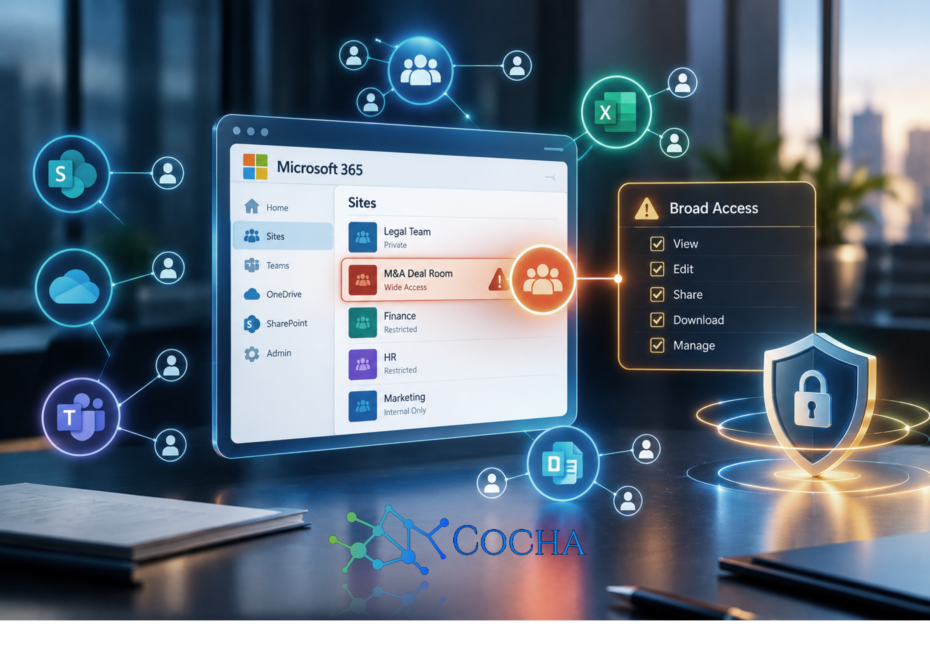
So, when a managing partner asks whether the firm is ready for a governed legal AI platform, the honest answer requires knowing things the vendor cannot see. How many SharePoint sites have broad or anonymous links that were never cleaned up. Whether HR keeps executive compensation in a team site because someone made it public three reorganizations ago. Whether external guests from an old client matter still hold access to a Teams workspace nobody remembers. Whether admins scoped their tenant-wide access the way they did in 2019, when nobody could reach the content anyway.
Vendor governance is the door lock. This inventory is knowing which of your rooms still have the windows open. Least privilege is the whole answer here, and it is a permissions problem before it is ever an AI problem, which is precisely why we keep saying AI readiness is a permissions project wearing an AI costume. The control plane cannot restrict access your tenant already granted, because from the platform’s point of view it is not restricted access. It is the access.
Hallucinated citations sit on the other side of the same coin. No governance plane, Google’s or anyone else’s, writes your verification policy, decides which filings need a second human review, or logs that the review happened. That is workflow and evidence, owned by the firm, provable to a court or a client or an insurer. If you want the deeper version of that argument, we wrote it up when the trust gap first surfaced in client questionnaires (AI risk mitigation and the law firm trust gap), and the underlying point has not aged a day since.
Three Questions That Decide Whether This Helps or Hurts Your Firm
You can put these in front of a partner committee this week, and the quality of the answers tells you where the firm stands on AI risk mitigation for law firms without a consultant in the room.
Question one: Could you list, by practice group, what an AI assistant connected today would be able to read?
Not what it should read, what it could. If the answer is no, and it is usually no, the firm is about to learn its own permission history through the assistant’s answers, in front of clients. This is the same oversharing inventory that makes Copilot rollouts go sideways, and it is exactly what we map before recommending anything, because nobody can govern a surface they cannot see. The mechanics are in your firm’s biggest AI risk.
Question two: Is citation and fact verification enforced, or is it expected?
The sanctioned lawyers in the database all worked at firms where verification was expected. Expected and enforced are different words. Enforced means a defined step, a named role, and an artifact that proves it ran. It also means you know which tools your people are already using to draft, because the shadow AI question is really a verification question with a compliance tail. Agent governance, including this, has its own write-up here.
Question three: Is there one sanctioned path for AI work, or twelve?
Every new entrant, and Gemini Enterprise for Legal is the biggest, adds a credible procurement option. Options are healthy. Twelve pilots are not. Without a sanctioned path, adoption spreads to whichever tool a practice group leader’s phone shipped with. The goal is not fewer tools; it is one governance frame around however many tools earn their place inside it.
What We Would Do This Week
If a firm asked us to make its Microsoft 365 estate honest enough to host any of these platforms, the sequence looks like this. It is the same AI risk mitigation for law firms order of operations we run for every buyer of the legal AI conversation, and none of it depends on which vendor wins.
Start with permissions. Inventory who can reach what across SharePoint and OneDrive, with particular attention to broad links, external guests, and admin scope. Then classify the sensitive material: privileged matter files, HR and compensation, M&A work, anything a client would be furious to see surfaced. From there, set the target state. Least privilege by role and matter, with deliberate exceptions written down and time boxed, because permissions nobody can explain are risk nobody can price.
Next, wire the workflow controls. Citation verification and human review as enforced steps with evidence, an AI use policy that names the sanctioned tools, and a review path for anything that drafts into a filing. Finally, the readiness check. A structured assessment of the estate against the platform you are evaluating, read only, no changes, findings written up for the partners and the IT director in the same document so nobody has to play translator. We will hand those findings to you in five business days. That shape is the AI Readiness Assessment, and it works whether the shortlist says Google, Microsoft, Harvey, or all of the above, because it grades the firm, not the vendor.
Here is a skeptical note we would rather say out loud: expect every platform conversation this fall to use the word governance heavily. The word is not the work- ask each vendor for the evidence your client questionnaire already demands. Their governance marketing and your governance posture are separate audits, and a good platform pitch should make your own audit easier to pass, not feel like it replaces the audit.
Start With Permissions, Not Platforms
The interesting thing about Google entering legal AI with a governance pitch, right as hallucinated citations hit a documented 2,000, is that it legitimizes the question firms should have been asking from the beginning. Who can see what? Who reviews what? How do we prove either one happened?
Platforms can supply control planes. Firms have to supply the truth about their own tenant and their own workflow. That order matters, and it is the whole reason our promise reads the way it does: get Copilot and Claude ready without exposing the wrong data. The vendor named in that sentence is negotiable: the permissions that work underneath it are not.
If your firm is sitting through a legal AI pitch this quarter, the fastest defensible move is a current map of what any of those assistants could already reach, plus a yes or no answer on whether review steps are enforced. Start with permissions, not platforms. When you want that map, the AI Readiness Assessment is how we begin.
Recent Posts
Have Any Question?
Call or email Cocha. We can help with your cybersecurity needs!
- (281) 607-0616
- info@cochatechnology.com
About the Author:

Steve Combs
Co-Founder & Managing Director, Cocha Technology
Steven is a fractional CIO/CISO with 30+ years of enterprise IT and security leadership. He has built AI governance frameworks for organizations with 1,700+ users, led enterprise Microsoft Copilot deployments, and conducted security assessments across law firms, energy companies, financial institutions, and PE-backed manufacturers.