8 Governance Controls to Turn on Before a Grok Bot Touches Your Portfolio Company’s Deal Data


AI Risk Mitigation for Law Firms: Closing the Trust Gap
September 4, 2026
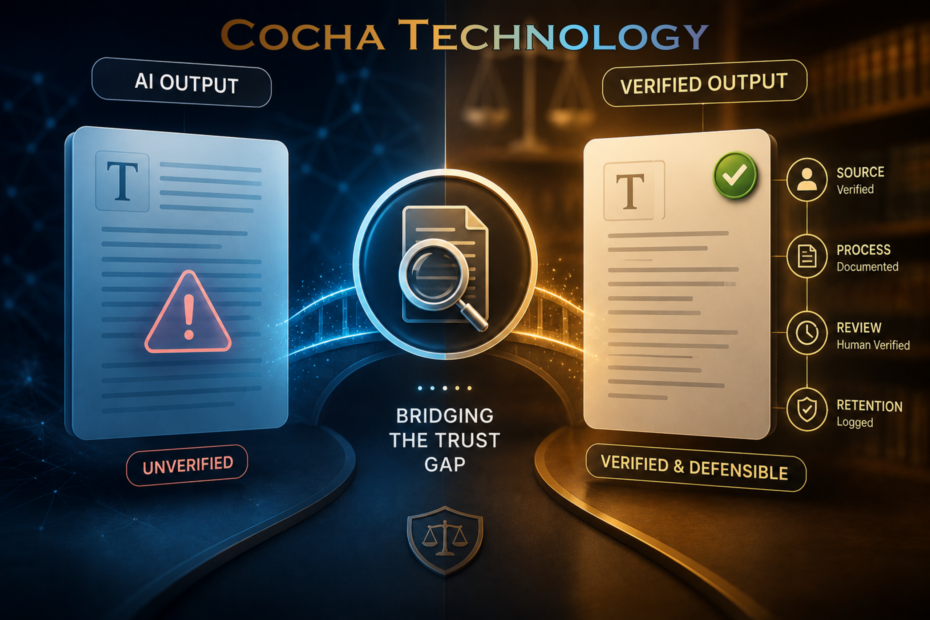
The question ILTACON couldn't dodge
Something shifted at ILTACON 2026 this year, and it wasn’t a new product launch. Thomson Reuters pushed CoCounsel Legal upgrades, Filevine ran a full campaign around its Legal Operating Intelligence System, the floor was as busy as ever. But the conversation in the hallways was different from last year’s.
Bloomberg Law’s Mat Rotenberg put it about as plainly as anyone could: the defining question coming out of the conference is no longer whether AI can produce the work. It can. The question is whether legal organizations can turn that output into trusted progress. I think that one line says more about where legal AI stands in 2026 than any vendor keynote did.
That’s the real shift behind AI risk mitigation for law firms right now. We’ve moved past “does the tool work.” We’re deep into “can you prove it worked, and can you prove it every single time.”
What "trusted progress" actually means
Here’s the thing about “trusted progress” as a phrase: it sounds soft until you sit with it. What it truly demands is uncomfortable. It means your firm needs to show, on request, how an AI-assisted brief got from prompt to filing. Who reviewed it. What was verified against a primary source and what wasn’t. Whether the client even knew AI touched their matter in the first place.
Firms walked out of ILTACON talking less about what a tool does and more about what it lets them do differently, and honestly, that’s the harder conversation. A tool that drafts fast is easy to sell internally. A governance program that can survive a client audit, a malpractice claim, or a judge’s standing order is a different project entirely, and it’s one a lot of firms haven’t started.
The numbers behind the trust gap
I don’t think this is a situation of firms being paranoid. The data backs up the concern. Wolters Kluwer’s 2026 Future Ready Lawyer research found that nearly six in ten in-house counsel, 59%, say they don’t know whether their outside counsel is using generative AI on their matters at all. Not whether it’s used well. Whether it’s used.
Sit with that for a second. Most clients are flying blind on a technology that touches their privileged, sensitive work product.
Nigel Lang, CIO at Fieldfisher, framed the trust question about as directly as I’ve seen anyone frame it: lawyers need to understand how the AI arrived at a conclusion, and security, auditability, and the extent to which humans remain in control all shape whether a system feels trustworthy. Not whether it’s fast. Whether it’s trustworthy. That’s a different bar, and it’s the one clients are starting to hold firms to.
Separate research on the broader legal industry found that 43% of firms have no formal AI policy and no plans to write one. Only 9% have a written policy that’s actually enforced day to day. That gap between “we use AI” and “we can govern our AI use” is precisely where AI risk mitigation for law firms needs to live, and right now it’s mostly empty space.
Why AI risk mitigation for law firms is now a client requirement, not a courtesy
A few years ago, this would have been an internal IT conversation. Now it’s showing up in engagement letters, in RFPs, in outside counsel guidelines. Clients aren’t asking if you use AI anymore. Some of them assume you do. What they’re asking is whether you can show your work.
That’s the practical core of AI governance for a law firm in 2026: not a slide deck, not a one-time training session, but a program you can point to. Something that shows which tools are approved, what data those tools can touch, who signs off on AI-assisted output before it leaves the building, and what happens when something goes wrong.
We wrote about the three-part risk mitigation framework we recommend to firms starting this work in our piece on AI risk mitigation for law firms, and it’s worth revisiting now that the conversation has shifted from adoption to proof. The framework hasn’t changed. What’s changed is how urgently clients want to see it in writing.
What a real audit trail looks like
This is where a lot of firms get stuck, honestly. Everyone agrees that an audit trail matters. Fewer firms can describe what theirs, in truth, looks like when a partner asks for it on a Friday afternoon.
A working audit trail for AI-assisted legal work needs a few concrete things: a record of which tool generated which draft, a verification step that’s documented rather than assumed, a named human who signed off, and a way to reconstruct the chain if a citation or a fact turns out to be wrong months later. None of that is exotic. It’s the same discipline firms already apply to conflicts checks and privilege logs, just pointed at a newer risk.
If your firm has an AI agent governance program, or is trying to start one up, we’ve laid out what that looks like in practice in our post on AI agent governance for law firms, including the parts most programs miss on the first pass, which tends to be less about the tool and more about who’s accountable when the tool is wrong.
When the trust gap turns into a malpractice problem
This isn’t hypothetical anymore, which is what makes it hard to wave off as a someday problem. Courts have been sanctioning attorneys over AI-fabricated citations for a while now, and the fines have stopped being symbolic. Six-figure penalties, bar referrals, attorneys removed from cases entirely. The pattern is not slowing down, it’s accelerating, and every one of those cases traces back to the same root failure: nobody verified the output before it went out the door.
Here’s what I think gets missed in the coverage of these sanctions’ stories. It’s rarely a firm using AI recklessly on purpose. It’s usually a reasonable governance gap, a verification step that existed on paper but wasn’t actually followed under deadline pressure or wasn’t followed by a contract attorney who never got the training. AI risk mitigation for law firms has to survive contact with a Friday-night deadline, not just a calm afternoon training session. That’s a genuinely hard design problem, and it’s exactly why so many firms are still working through it.
Malpractice carriers are paying attention too. A few have started asking pointed questions about AI use during renewal, and I’d expect that to become standard within a year or two, not optional. Firms that can produce a documented governance program at renewal time are going to have an easier conversation than firms that can only say, “we tell people to double-check things.”
Three questions to ask before your next AI-assisted filing
Rather than a long checklist nobody reads, here are three questions worth asking out loud in your next practice group meeting:
- First, if a client asked us right now whether AI touched their matter, could we answer honestly and specifically, not just “we have a policy somewhere”?
- Second, who verified the citations in the last AI-assisted brief we filed, and is that documented anywhere a malpractice carrier could, in effect, find it?
- Third, if our AI vendor changed its model or its data retention terms tomorrow, would we even know, and would it change what we’re willing to let that tool touch?
If any of those made you pause, that’s worth paying attention to. We put together a broader look at where firms tend to get caught out in our post on your firm’s biggest AI risk, and it’s less about exotic failure modes than it is about the everyday gaps nobody flagged as urgent until a client asked.
Building the program without boiling the ocean
I’ll be honest, when firms hear “documented AI governance program” a lot of partners picture a six-month project with outside consultants and a binder nobody opens again. It doesn’t have to be that. The firms making real progress on AI risk mitigation for law firms right now are starting narrow and specific, not broad and theoretical.
That usually looks like picking the two or three practice areas where AI tools are already in daily use, whether firm leadership formally approved that or not, and building the verification and sign-off process around those first. Then it’s writing down, in plain language, which tools are sanctioned, what data can and can’t go into them, and who owns the “did we check this” step for each type of work product. Not a fifty-page policy. A one-page answer to “what would we tell a client who asked.”
What tends to surprise firms once they start this work is how much shadow AI use they find. Associates using consumer-grade tools nobody approved, because the approved tool was slower or clunkier. That’s not a discipline problem so much as a design problem, and it’s usually the first thing worth fixing, since it’s hard to govern what you don’t know is happening.
Where to start
None of this means firms should slow down on AI adoption. That ship has sailed, and honestly it should have. What it means is that the firms winning client trust in 2026 aren’t the ones with the flashiest tools. They’re the ones who can answer questions about those tools without flinching.
The full ILTACON 2026 coverage from Artificial Lawyer is worth a read if you want the ground-level view from the conference floor. And the Wolters Kluwer Future Ready Lawyer research is a good gut check on where client expectations actually sit right now, versus where firms assume they sit.
If you’re not sure where your firm stands on any of this, that’s a reasonable place to start. Not with a new tool. With an honest look at what you can currently prove.
Ready to see where your firm's AI governance actually stands?
Cocha Technology’s AI Readiness Assessment gives you a clear, documented picture of your current AI risk posture, gaps in oversight, and what a defensible governance program looks like for your firm specifically. Reach out to get started.
Recent Posts
Have Any Question?
Call or email Cocha. We can help with your cybersecurity needs!
- (281) 607-0616
- info@cochatechnology.com
About the Author:

Steve Combs
Co-Founder & Managing Director, Cocha Technology
Steven is a fractional CIO/CISO with 30+ years of enterprise IT and security leadership. He has built AI governance frameworks for organizations with 1,700+ users, led enterprise Microsoft Copilot deployments, and conducted security assessments across law firms, energy companies, financial institutions, and PE-backed manufacturers.