8 Governance Controls to Turn on Before a Grok Bot Touches Your Portfolio Company’s Deal Data


AI Agent Governance for Law Firms: The 12% Problem
July 22, 2026
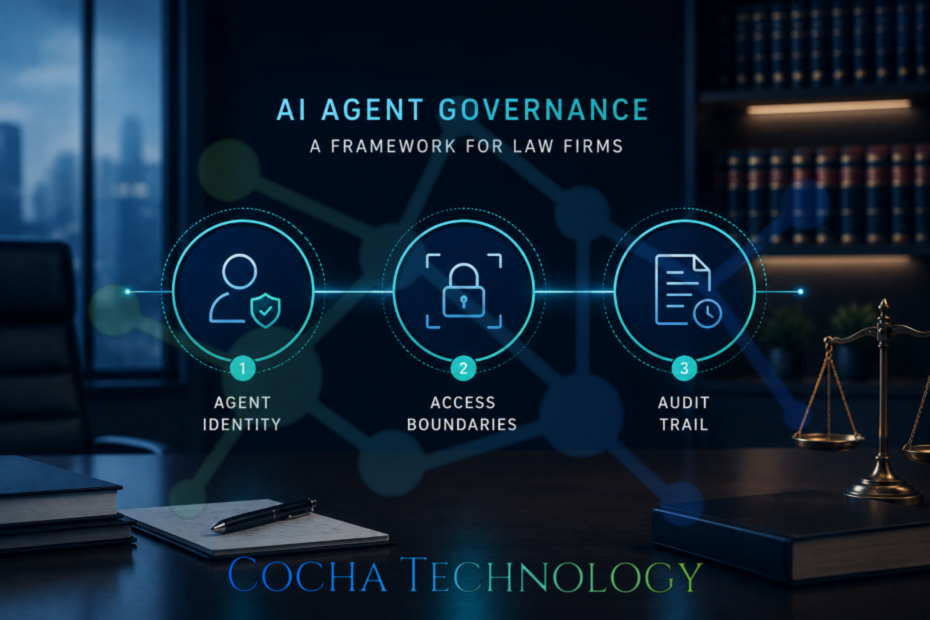
Ninety six percent of enterprises are running AI agents right now, in production, doing real work. Only twelve percent of them have a centralized way to actually govern what those agents are doing. That number comes from OutSystems’ 2026 State of AI Development report, which surveyed 1,900 IT leaders worldwide, and I think it should stop every managing partner cold. Law firms are not the exception to that stat. They are squarely inside it, and AI agent governance for law firms is quickly becoming the gap that separates firms who get ahead of this from firms who end up explaining it to a client after something goes wrong.
Here’s the thing about agent governance for law firms specifically: most firms already have some version of an AI use policy. Maybe it names ChatGPT, maybe it names Copilot, maybe it lists a couple of approved research tools. What it almost never covers is what happens once those tools stop being tools you type a prompt into and start being agents that act on their own, pulling documents, drafting communications, moving through a matter across several steps without someone reviewing each one. That’s where the governance gap actually lives, and it’s a lot wider than most firms realize.
Why This Hits Law Firms Harder Than Most Industries
Every industry has some version of this problem, but law firms carry a few extra layers most companies don’t. Privilege is one. If an AI agent pulls a privileged document into a workflow it wasn’t scoped to touch, that’s not just a security incident, it’s a potential waiver argument opposing counsel gets to raise later. Client confidentiality is another. A firm representing competing interests across different matters cannot afford an agent that quietly bridges data it should never have connected in the first place.
Then there’s malpractice exposure, which courts have already shown they take seriously when AI is involved, even for something as basic as a hallucinated citation typed by a human lawyer. Add an autonomous agent making its own sequence of decisions into that mix, without a clear record of what it did and why, and the exposure only grows. This is the same territory we walked through in your firm’s biggest AI risk, except agents raise the stakes because nobody typed the risky step by hand. Governance is not a compliance checkbox here. It’s the thing standing between “we used AI carefully” and “we can’t actually tell you what our AI did.”
What AI Agent Governance Actually Means
A written policy that says “use approved AI tools only” is not agent governance. It’s a starting point, and a fairly thin one at that. Real AI agent governance for law firms means knowing, for every agent running inside the firm, who owns it, what it’s allowed to touch, what it did, and who would notice if it did something it shouldn’t have.
That breaks down into a few concrete pieces. Agent identity, so every agent has a traceable identity the same way a person does, not a shared service account nobody remembers creating. Access boundaries, so an agent doing contract review cannot also quietly pull client billing data because nobody scoped its permissions down. And an audit trail, so when a partner asks “did our AI touch this privileged document,” there’s an actual answer instead of a shrug and a promise to look into it.
Most firms have none of this built out yet, which, again, tracks with that OutSystems number. Ninety four percent of the organizations in that same survey said agent sprawl is already adding to technical debt and security risk, and only a slice of the industry has real central visibility into what’s running.
Even the AI Vendors Know Governance Is the Real Fight Now
What’s telling is watching how the big AI vendors are positioning themselves this year. Google’s new Gemini Enterprise Agent Platform, announced this spring, is built almost entirely around governance rather than raw model capability. It ships with an Agent Registry to catalog every agent running in an environment, Agent Identity for access control and auditing, and a policy enforcement layer Google calls Agent Gateway. Read between the lines and the message is pretty clear: capability stopped being the differentiator a while back, and governance is where the real competition is now.
OpenAI made a quieter but related move. Its Workspace Agents shifted to metered, usage-based billing in July, which means every agent run now leaves a cost record behind it. That was framed as a pricing change, and it is, but it also means there’s now a built-in usage trail that didn’t exist during the free preview period. Firms adopting these tools should treat that as an opportunity, not just a line item to budget around. If the vendor is already tracking every agent run for billing purposes, that same data can and should feed into a firm’s own oversight process instead of sitting unused in a billing dashboard nobody, but accounting ever opens.
Neither of these moves happened because vendors suddenly got generous with visibility. They happened because enterprise buyers, including law firms, started asking harder questions before signing. That’s worth remembering the next time a vendor pitch leans heavily on capability and lightly on how you’d actually audit what their agent did last week.
Where This Bites a Law Firm Specifically
Picture a mid-sized firm where three practice groups have each quietly adopted a different AI research or drafting tool over the past year, none of it centrally approved, none of it tracked by IT. That’s shadow AI, and it’s a much bigger exposure once the tools involved are agents instead of chat windows, because an agent doesn’t wait for someone to hit send. It acts, on its own timeline, sometimes touching three or four systems before a human ever sees the output.
Permission creep compounds the problem. An agent set up eighteen months ago for one narrow task often ends up with broader access than anyone intended, simply because nobody revisited its scope as the firm’s systems changed around it. I’ve seen this exact pattern show up in plain cloud infrastructure long before agentic AI made it worse, and it rarely gets caught until something forces the question, usually an audit, a client security questionnaire, or worse.
None of this is hypothetical risk. It’s the same category of exposure firms are already tracking around AI generally, just moving faster and with fewer human eyes on it at each step along the way.
How Law Firms Can Build AI Agent Governance This Quarter
Start with an inventory, and be honest about it. Every AI tool touching firm or client data, whether IT approved it or not, needs to land on a single list before anyone can govern anything. Skipping this step is the single most common reason governance efforts stall out before they really start.
From there, map access for each agent on that list. Write down what data and systems it can actually reach, not what it was originally intended to reach when someone set it up. Those two things drift apart faster than most people expect, especially in firms where practice groups manage their own tools independently.
Assign an owner to every agent, a real named person, not a department. Ownership without a name attached tends to dissolve the first time something needs fixing.
Then build the audit habit before you need it, not after. Whatever tool or process tracks agent activity should be something a partner can pull up on short notice, not something IT has to reconstruct from logs scattered across three different systems under deadline pressure.
Finally, revisit the list on a set schedule, quarterly is reasonable for most firms, rather than only when a new tool gets added. Agent governance decays quietly if nobody’s checking on it.
None of this requires waiting on a vendor to hand a firm a finished governance platform. It’s mostly discipline, applied consistently, starting now rather than after an incident forces the issue and a client asks pointed questions the firm can’t fully answer.
There’s also a business development angle worth mentioning, one firms tend to overlook until it’s already come up in a pitch. Sophisticated corporate clients, especially in regulated industries, have started adding AI agent governance questions directly into outside counsel questionnaires. Not “do you use AI,” which almost everyone answers yes to now, but specifically how agent activity gets tracked, who owns each agent, and what happens when one touches something it shouldn’t. A firm that can answer those questions cleanly, with a real inventory and a real owner list behind the answer, has a genuine edge over a firm that has to scramble to find out.
Questions Worth Asking Before Approving the Next Agent
Before any practice group adds another AI agent to its workflow, a few questions are worth putting in writing rather than assuming the answer. Who owns this agent day to day, by name. What data and systems can it actually reach, confirmed rather than assumed. How would anyone know if it did something outside its intended scope. And who reviews that activity, and how often.
If a firm can’t answer all four cleanly for every agent already in use, that’s the actual starting point, more than any policy document sitting in a shared drive.
The Bottom Line
The AI agent governance gap isn’t a future problem law firms can plan for later. It’s already here, and the data says most organizations, including most firms, are behind on it. The good news, if there is one, is that the firms who get their arms around agent identity, access, and audit trails now are building a real advantage over competitors still treating AI governance as a document nobody reads after onboarding.
If your firm hasn’t inventoried what AI agents are actually running yet, that’s the right place to start, and it pairs naturally with a broader look at where access controls stand across the firm’s systems. A Zero Trust Assessment is a practical next step for firms that want a clear picture of who and what can reach their data before agent sprawl makes that picture harder to see.
Recent Posts
Have Any Question?
Call or email Cocha. We can help with your cybersecurity needs!
- (281) 607-0616
- info@cochatechnology.com
About the Author:

Steve Combs
Co-Founder & Managing Director, Cocha Technology
Steven is a fractional CIO/CISO with 30+ years of enterprise IT and security leadership. He has built AI governance frameworks for organizations with 1,700+ users, led enterprise Microsoft Copilot deployments, and conducted security assessments across law firms, energy companies, financial institutions, and PE-backed manufacturers.