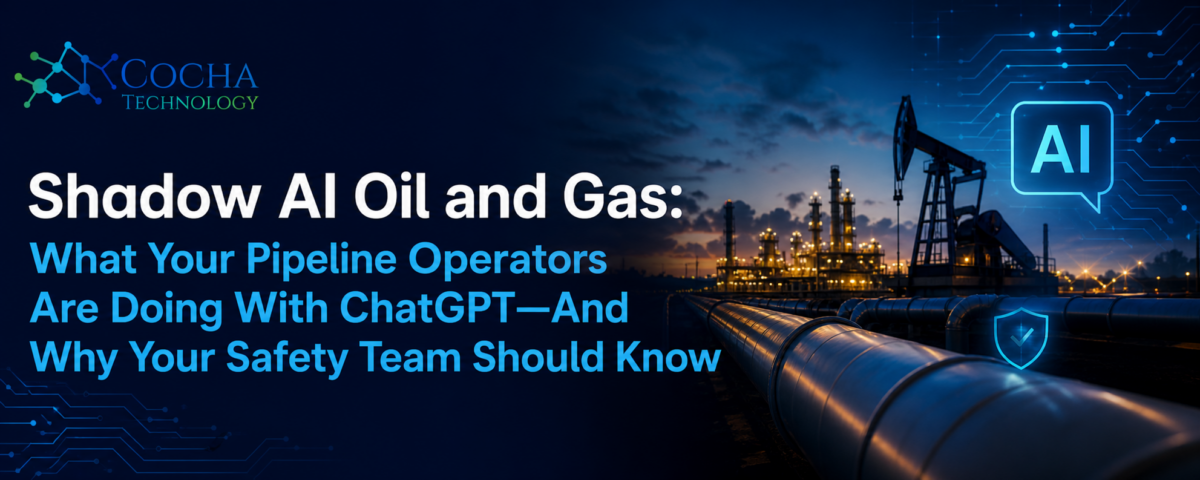
Shadow AI Oil and Gas: 5 Dangerous Ways It Impacts Pipeline Safety
May 4, 2026
In our thirty years of consulting for the energy sector, we have walked through hundreds of control rooms, from the high-tech hubs of Houston to remote compressor stations in the Appalachian Basin. In every one of them, the primary goal is the same: maintain pressure, prevent leaks, and keep the product moving safely. Historically, we did this through rigorous training, thick manuals, and “Air Gapped” SCADA systems.
But as we move through 2026, a new variable has entered the control room: shadow AI oil and gas.
The “Shadow” isn’t a malicious hacker in a hoodie—it’s your most diligent, tech-savvy operator trying to do their job better. They are using ChatGPT, Claude, and Gemini to “summarize” complex safety manuals, “debug” SCADA alerts, and even “optimize” pressure flow calculations. While their intent is productivity, the result is a massive, unmapped safety and security risk. According to a recent study by IBM Security, 38% of employees now acknowledge sharing sensitive work information with AI tools without permission. In the pipeline world, “sensitive data” means your infrastructure’s physical vulnerabilities.
1. The "Safety Manual" Hallucination Risk
One of the most common ways shadow AI oil and gas technology is used is for document summarization. Imagine a junior operator faced with a 400-page manual on a legacy valve system during a pressure transient event. They don’t have time to read the whole thing, so they paste a section into ChatGPT and ask for the “Step-by-Step Emergency Shutdown Procedure.”
The risk? AI hallucinations. While LLMs are brilliant at language, they can confidently misinterpret technical specifications or “hallucinate” a step that doesn’t exist. In a high-stakes environment, a 95% accurate procedure is a 100% safety failure. If your safety team hasn’t mapped which AI tools are being used to interpret life-safety documents, you are operating on a foundation of “Shadow” logic.
✦ The “Hallucinated” Setpoint:
We once saw a situation where a field tech used an AI tool to “simplify” a complex chemical injection formula for a pipeline. The AI gave a confident answer that looked correct but failed to account for the specific ambient temperature of that basin. The result was a chemical imbalance that caused thousands of dollars in corrosive damage to the pipe wall. The tech thought they were being efficient; the AI was just guessing at the context it didn’t have.
2. Exposing Physical Vulnerabilities via "Prompt Leaks"
Every time an operator pastes a SCADA log or a network diagram into a public AI tool to “troubleshoot” a connectivity issue, they are effectively “donating” your infrastructure map to a public cloud. In the world of shadow AI oil and gas, these are known as prompt leaks.
If an attacker were to query that same AI for “Vulnerabilities in Acme’s pipeline network,” the AI could potentially piece together the information provided by your own operators. This isn’t just theory; security researchers in 2026 have already identified vulnerabilities where “side-channel attacks” can siphon data from AI conversation histories.
3. The Death of the "Air Gap" through Personal Devices
For decades, we relied on the “Air Gap” to protect pipeline OT (Operational Technology) from IT threats. But today, every operator has a smartphone in their pocket. If they are manually typing SCADA alerts into a public AI app to understand what a “Fault Code 402” means, the gap is gone.
Your safety team may think the system is isolated, but if the “logic” for fixing that system comes from an unmanaged, public cloud, you have a shadow AI oil and gas connection that you can’t monitor or control. This is why a Zero Trust Assessment is no longer optional—it is a survival requirement.
4. Adversarial AI and Model Poisoning
A growing risk in 2026 is “Model Poisoning.” If a nation-state actor knows that your industry relies on public AI tools for general troubleshooting, they can “poison” the training data for those tools with subtly incorrect safety advice.
In a shadow AI oil and gas environment, your operators might be receiving “optimized” advice that was actually designed by an adversary to cause a pressure imbalance or mask a leak signature. According to Industrial Cyber, only 14% of energy organizations currently have an AI-specific incident response playbook.
5. Non-Productive Time (NPT) and Data Integrity
Non-Productive Time (NPT) and Data Integrity
✦ We’ve seen 30 years of “Fast Solutions” turn into “Long-Term Disasters.” If your operators are using ChatGPT to solve pipeline puzzles, they are gambling with your physical assets. You need to give them a “Sanctioned” tool, so they don’t have to go into the shadows.
Bridging the Safety Gap with Shadow AI Protection
You cannot manage what you cannot see. The first step to reclaiming your pipeline’s safety is a Zero Trust Assessment. This allows us to map the digital footprint of your operators and identify which “Shadow” tools are currently touching your data.
Through our Shadow AI Protection service, we help you build a “Ring Fence” around your operations. We don’t just block AI; we provide a secure, siloed alternative that allows your operators to be efficient without being dangerous. We ensure that your SCADA data and safety manuals remain within a “Closed Loop” where the AI is an assistant, not an unmanaged risk.
Turning the Lights on Pipeline Autonomy
In 2026, resilience means realizing that your “Air Gap” has moved into the cloud. Shadow AI oil and gas usage is a symptom of a workforce that wants to be more efficient. Your job is to make sure that efficiency doesn’t come at the cost of a catastrophic failure.
At Cocha Technology, we combine 30 years of IT veteran experience with cutting-edge security to ensure your pipeline remains safe, secure, and visible. Let’s make sure your “Shadows” don’t become your “Leaks.”
Is your pipeline safety being managed by a public chatbot? Secure your infrastructure with a Zero Trust Assessment today and turn the lights on your digital operations.
Recent Posts
Have Any Question?
Call or email Cocha. We can help with your cybersecurity needs!
- (281) 607-0616
- info@cochatechnology.com
About the Author:

Steve Combs
Co-Founder & Managing Director,
Cocha Technology
Steven is a fractional CIO/CISO with 30+ years of enterprise IT and security leadership. He has built AI governance frameworks for organizations with 1,700+ users, led enterprise Microsoft Copilot deployments, and conducted security assessments across law firms, energy companies, financial institutions, and PE-backed manufacturers.