A successful summary does not approve a connector
Firms finish a narrow pilot, see a clean document summary, and then ask to “turn on the matter system connector.” That request changes the security model. The agent is no longer limited to an approved local folder. It can reach live repositories, mail, or other tools through product connectors.
Nashville law firms and regulated mid-market teams evaluating Claude Enterprise, Copilot-related connectors, or other agent tooling need a deployment decision record for that expansion. The question is not whether connectors exist. The question is which actions are approved, which stay read-only, and who can pause the workflow.
This guide is technical deployment education. It is not Tennessee ethics advice.
Read Tennessee educational notes without inventing a formal opinion
Tennessee Board of Professional Responsibility Board Notes, Fall 2024, include an educational article on generative AI hallucinations and discuss ABA Formal Opinion 512 themes. Treat that material as educational discussion for lawyers to read with counsel. It is not a Tennessee formal AI ethics opinion.
Before any public claim about the presence or absence of a Tennessee formal AI opinion, recheck the current formal-opinion index. This article makes no absence claim. ABA Formal Opinion 512 is national context, not Tennessee law; verify the primary ABA text before quoting it in later guest pieces.
Keep hallucination and verification duties with counsel and supervising lawyers. Keep connector gates with the technical and risk owners who can enforce them.
Decide whether the pilot evidence supports expansion
The Atlanta Claude Enterprise governance hub explains the initial launch boundary. A successful local-file pilot does not establish that a new repository may be connected. AI connector approval gates should ask what changes, what evidence supports the change, and who can refuse it.
Bring the completed pilot record to the review. If the team cannot reconstruct a sample task or remove a test user’s access, defer expansion. Adding another data source will not repair those gaps.
Record a separate decision for each connector
Do not approve integrations as a bundle. Describe the proposed workflow and the additional information it would reach, then attach evidence against the approved scope.
| Decision gate | Evidence for the reviewer | No-go condition |
|---|---|---|
| Need for expansion | Named workflow owner and reason local files are insufficient | No defined use beyond trying another feature |
| Information admission | Approved data classes and excluded repositories | Restricted information lacks an approval record |
| Read scope | Test results showing permitted and denied access | Neighboring repositories remain reachable |
| Action scope | Recorded read-only result; separate request for writes | Writes or sends inherit approval from a read test |
| Investigation readiness | Sample events available to the evidence owner | The reviewer cannot reconstruct the test |
| Reversal | Tested disable path with a named owner | Nobody can stop access when a boundary fails |
| Remaining risk | Named acceptance, limitations, and review date | Unresolved gaps have no authorized owner |
The review can end with a bounded yes, a request for more evidence, or a no. Record the outcome and the conditions that would reopen it. A read-only approval applies only to the tested population and corpus.
Keep implementation evidence outside the decision narrative
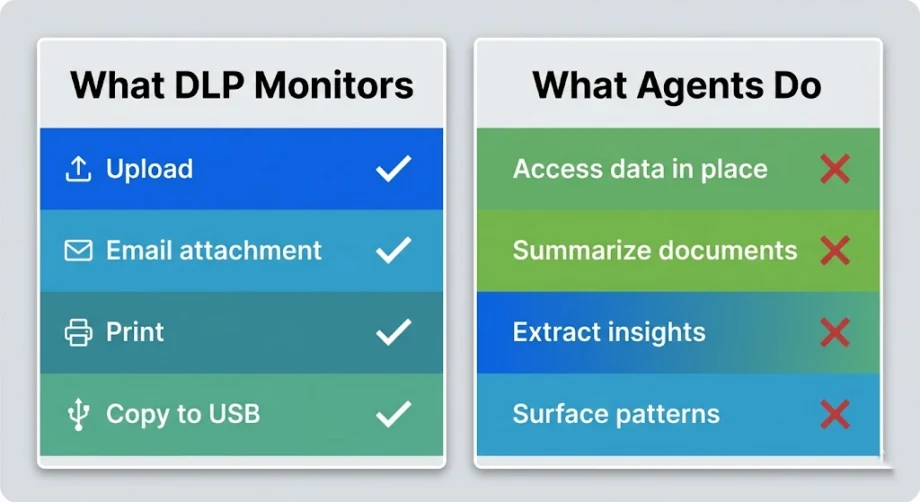
The DLP guide for Claude and Copilot connectors covers a related data-boundary problem. Use it during technical review rather than treating connector approval as a substitute for that work.
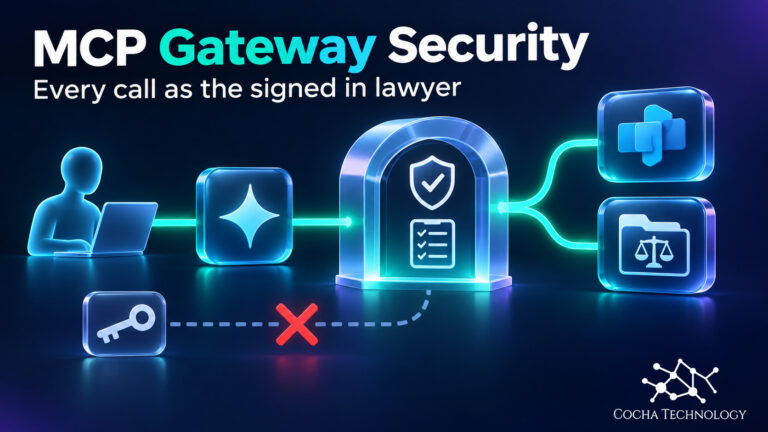
This article does not explain gateway architecture or configuration. Those details are in MCP gateway security for law firms. The decision record should point to the relevant test results, not reproduce setup instructions.
Reopen approval when the proposed capability changes
A request to add writes, another repository, or more users is a new decision. Compare the requested change with the last approved record. Require evidence for the difference before extending access.
A conditional yes needs a deadline and a person responsible for checking the condition. If required evidence does not arrive, the capability stays disabled. Calendar pressure is not risk acceptance.
Quick answers
Why does a successful summary not approve a connector?
A connector changes the security model. The agent is no longer limited to an approved local folder and can reach live repositories, mail, or other tools.
What should AI connector approval gates require?
Evidence for need, information admission, read scope, action scope, investigation readiness, reversal, and remaining risk, recorded separately for each connector.
When should expansion stop?
Do not expand connectors to solve an intake problem or to compensate for missing monitoring. If sample tool events never arrive, stop.
What outcome can the review produce?
A bounded yes, a request for more evidence, or a no. Record the outcome and the conditions that would reopen it.
Close with a pause rule
Do not expand connectors to solve an intake problem. If confidential information still lacks an approved-input decision, fix intake first. Do not expand connectors to compensate for missing monitoring. If sample tool events never arrive, stop.
Nashville and Southeast buyers should ask a technical provider to show the read-only test, the negative test, and the disable path before production data is linked. Agree whether the engagement is advisory or hands-on before anyone changes tenant settings.
For a focused starting review, request the free AI Readiness Snapshot. It makes no changes to your environment and installs no software. Use the findings to decide whether identity, logging, and data boundaries are ready for a connector conversation.