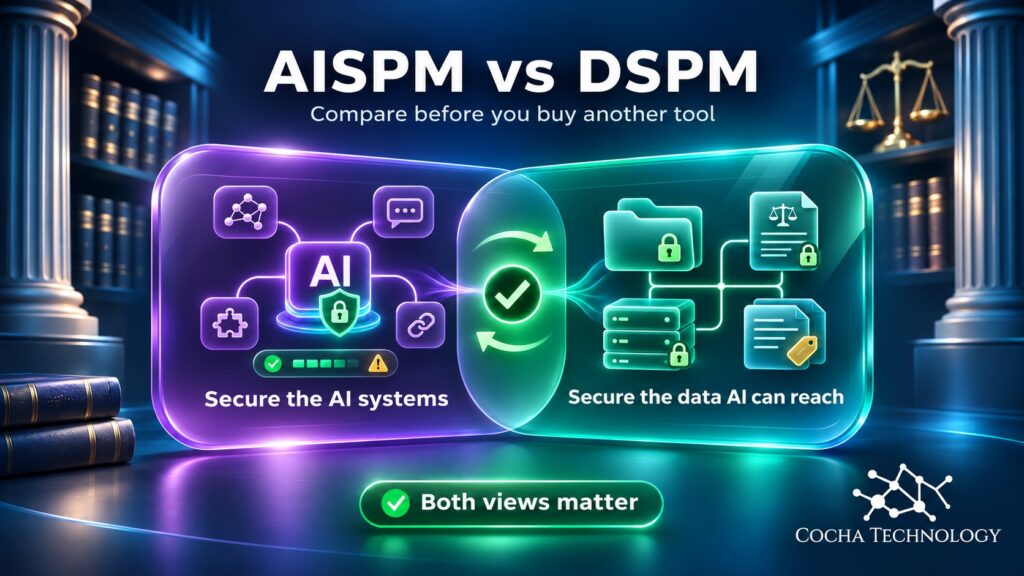
AISPM and DSPM answer different questions. AISPM asks what AI systems your organization runs and how they’re configured. DSPM asks where sensitive data lives and who can reach it. For a law firm with Copilot or Claude in pilot, we’d usually answer the data question first.
Microsoft documents that Copilot only surfaces organizational data the user has permission to view. Broad permissions can therefore become an AI exposure. For Claude, check the access granted to each enabled connector rather than assuming it follows the same model.
That ordering isn’t universal. A firm building its own agents on Microsoft Foundry has a different exposure, and AISPM speaks directly to it. The sections below separate the two so you can see which gap your firm has.
What AISPM covers
Vendors use AI security posture management for products that inventory AI assets, evaluate their configuration, and surface risk. The details differ by product. Microsoft’s version makes a useful concrete example because its documentation is public.
In Microsoft Defender for Cloud, AI security posture management includes capabilities in the Defender Cloud Security Posture Management (CSPM) plan. It discovers what Microsoft calls the AI bill of materials: application components, data, and AI artifacts from code to cloud. Recommendations address identity, data security, and internet exposure. Attack path analysis helps identify risks, including externally reachable AI endpoints.
The discovery list on that page names Azure OpenAI Service, Azure AI Foundry, Azure Machine Learning, Amazon Bedrock, and Google Vertex AI. Those are the labels in the workload list; its agent section uses Microsoft Foundry. Microsoft labels its agent-discovery section Preview. Agent discovery has a separate licensing boundary. Microsoft states that, effective July 1, 2026, AI agent discovery and security posture for Microsoft Foundry agents and third-party cloud agents require Microsoft Agent 365. Defender CSPM continues to discover Microsoft Foundry accounts and projects. Confirm current licensing before you plan around it.
Read that scope for what it leaves out. In our view, a scanner focused on workloads in your cloud accounts is a limited starting point for a firm using only subscribed assistants. Don’t assume it inventories the firm’s Microsoft 365 Copilot or Claude use. Ask the vendor to demonstrate SaaS and agent coverage separately. That’s Cocha’s reading of the documented scope, not a Microsoft claim that these services are invisible to every security product.
Don’t confuse AISPM with plain CSPM either. Cloud security posture management checks cloud resource configuration; AISPM applies a posture view to AI workloads. Our DSPM vs CSPM comparison covers where cloud configuration posture stops and data posture starts.
What DSPM covers
Data security posture management finds sensitive data, shows who and what can reach it, and helps prioritize exposure. Our overview of data security posture management covers the basics. Microsoft describes its Purview version as a way to discover, protect, and investigate sensitive data risks across the digital estate.
Microsoft Purview Data Security Posture Management for AI (classic) focuses on AI use. It offers activity insights, one-click policies, and data risk assessments for potential oversharing in SharePoint. Our DSPM for AI guide walks through the reporting and prerequisites.
One distinction matters for planning. A report doesn’t block an interaction. DSPM for AI can help create policies in other solutions, including Microsoft Purview Data Loss Prevention and information protection. Those configured controls provide enforcement. SharePoint Restricted Content Discovery is another available action for limiting discovery. Don’t mistake viewing a finding for applying a control.
The broader statement that DSPM can only report would be wrong. Microsoft’s current Data Security Posture Management documentation describes guided remediation and automated actions, including removing public sharing links or applying DLP policies. The classic experience also offers remediation actions. Check what action is configured, which solution performs it, and who approves it.
Naming has changed too. Microsoft now labels the earlier experiences DSPM for AI (classic) and DSPM (classic). The current Microsoft Purview Data Security Posture Management experience supports AI apps and agents with broader coverage and guided workflows. Check which experience you’re using before following a guide, including ours.
Side by side
This is a comparison of the documented Microsoft examples, not a feature guarantee for every product in either category.
| Question | AISPM example | DSPM, including DSPM for AI |
|---|---|---|
| Main question | What AI systems exist, and how are they configured? | Where is sensitive data, and who can reach it? |
| Watches | AI workloads, endpoints, and dependencies within supported scope | Data access, sensitive content, policy coverage, and supported AI interactions |
| Typical finding | An internet-reachable AI endpoint or risky attack path | An overshared SharePoint site or sensitive content in an AI interaction |
| What we’d verify separately | Whether a subscribed assistant can read an overshared matter library | Whether a custom agent’s infrastructure is misconfigured |
| Action boundary | Recommendations and attack path findings still need a response | Reporting isn’t enforcement; current DSPM also supports remediation workflows and configured actions |
In our view, the separate checks in this table are the practical blind spots to test during a comparison. They’re Cocha’s buying questions, not claims that either category can never cover the other concern.
Where they overlap
Both depend on inventory. You can’t evaluate the posture of AI you don’t know about. Microsoft’s classic DSPM for AI walkthrough lists device onboarding and the Microsoft Purview browser extension as prerequisites for third-party AI sites. Cloud workload discovery depends on supported services and connected environments.
Coverage needs testing. Don’t assume either dashboard captures every interaction on a personal device or in an unconnected app. Ask how each source enters the inventory and what falls outside it.
A decision path for firms with Copilot and Claude in pilot
We’d start from the exposure you have today.
- List the tools in use and their purpose. Include Copilot, each Claude plan, and other AI services identified in available web traffic. This supports the context-setting work in the Map function of NIST’s AI Risk Management Framework. NIST also places AI inventory mechanisms in Govern 1.6. An inventory alone doesn’t complete either function.
- Check what each tool can read. Copilot works within the user’s existing access. An overshared matter workspace can therefore be exposed through Copilot. Ask the access question separately for every connector enabled for another assistant.
- Fix permissions and labels. This is data posture work. Give each finding an owner and check that the intended access boundary holds after the change.
- Then decide on AISPM. If the firm builds or hosts AI workloads or custom agents, we’d evaluate an AISPM view alongside the data view. If every assistant is a subscription, we’d prioritize data access while checking whether the proposed AISPM product adds useful SaaS coverage.
There is a fair counterargument. A CISO fielding board questions about agents may reasonably want the AI inventory first. That works, as long as nobody treats an AISPM dashboard as evidence that matter data is safe from an assistant.
In our view, posture-tool findings can support NIST’s Measure and Manage functions, while ownership and policy decisions need the continuing work described under Govern. That’s Cocha’s application of the framework, not a NIST product mapping. NIST treats Govern as cross-cutting and says the functions aren’t an ordered checklist.
Questions to ask any AISPM vendor
- Which AI assets does it discover, and how? Cloud deployments, SaaS assistants, and browser use are different problems.
- Does it read data content, or only configuration?
- Does it report, enforce a rule, or trigger a separate remediation workflow?
- What licenses does it depend on, and which capabilities have moved to another plan?
- Who in your firm will own the findings?
Find out which view your firm is missing
If you can’t tell whether the gap is in the AI stack or in the data underneath it, start with the free AI Readiness Snapshot.
The working session is about 60 minutes, with separate preparation and a findings review. Your administrator runs read-only tooling and shares the agreed output. You receive a findings report. There are no changes to your environment and no software to install. It’s a focused starting point, not a full tenant audit.
Frequently asked questions
What does AISPM stand for?
AI security posture management. It’s an industry term for tracking the security posture of AI systems and the controls around them. Vendors define the scope differently, so ask what a product inventories before comparing it with another.
How is AISPM different from DSPM?
AISPM centers on AI systems, such as models, agents, and endpoints. DSPM centers on sensitive data, its access, and its use. The views overlap. One dashboard shouldn’t be assumed to answer both sets of questions.
Is DSPM for AI the same as AISPM?
No. DSPM for AI is a Microsoft Purview experience for data risk around AI use, now labeled classic. Its reporting doesn’t block anything on its own, though it can help configure protective policies and remediation. Microsoft also uses AI security posture management for separate Defender for Cloud capabilities.
Which should a law firm buy first?
We’d start from the exposure you already have. If an assistant can reach matter data, review data posture and permissions first. If the firm builds or hosts AI workloads, evaluate AISPM alongside that work. The free AI Readiness Snapshot can help identify the questions to investigate next.
Does Cocha sell an AISPM product?
No. Cocha does readiness and governance work for Copilot, Claude, and related controls. This article doesn’t recommend a particular posture product.