AI Risk Mitigation for Law Firms: The Sanctions Are Rising, and They All Say the Same Thing


Future-Proof Your Compliance: Why AI Data Governance is the Only Path Forward in 2026
January 23, 2026
Remember when we all thought the cloud was the finish line? We spent years planning migrations, convinced that once the servers were off-premise, the hard work was over. But here we are in 2026, and for most IT leaders, the reality feels a lot different.
The cloud didn’t magically organize our mess; it just gave us a bigger, faster warehouse to store it in.
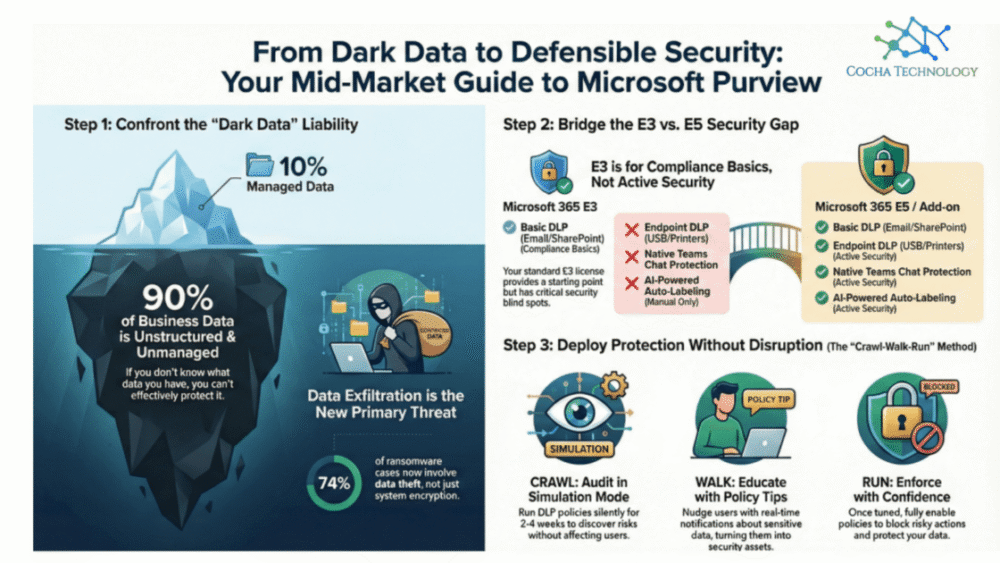
Right now, the average enterprise is sitting on upwards of 10 petabytes of unstructured data. To put that in perspective, that’s roughly the equivalent of 10 trillion books. And the scary part? Most of it is “Dark Data”—unclassified, unmanaged, and effectively invisible to your security teams.
The old rule-based systems we relied on for the last decade are buckling under the weight. They’re noisy, they require too much manual intervention, and frankly, they can’t keep up. To actually thrive in this environment, we have to stop treating security as a static checklist. We need to pivot toward AI Data Governance—transforming our defense from a passive gatekeeper into an intelligent, active shield.
The Death of the "Lift and Shift" Migration
When the rush to the cloud happened, most organizations took the path of least resistance: the “lift and shift.” We took terabytes of file shares and dumped them straight into SharePoint or OneDrive without looking inside the boxes first. It promised speed, but it delivered chaos.
You can’t protect what you can’t see. When you move disorganized data, you’re just re-hosting your liability in a more accessible environment.
A modern AI Data Governance strategy forces us to look in the mirror before we migrate—or at least before we go any further. It starts with identifying the “ROT”—Redundant, Obsolete, and Trivial data. There is no reason to pay storage costs for lunch menus from 2018 or draft copies of projects that were killed five years ago.
But beyond cleaning house, there’s a more urgent reason to get this right: Microsoft 365 Copilot.
We love what AI can do for productivity, but we have to remember that Copilot respects existing permissions. If your data is overshared—if “Everyone” has access to the CEO’s draft folder because of a sloppy migration years ago—Copilot will dutifully surface that sensitive info to anyone who asks the right question. Without proper AI Data Governance, your productivity tools can accidentally become your biggest leak.
From Rigid Rules to Intelligent Recognition
If you’ve ever worked in a SOC (Security Operations Center), you know the pain of legacy Data Loss Prevention (DLP).
Old-school data loss protection was blunt. It relied on simple pattern matching—usually Regular Expressions (RegEx). If it saw a 16-digit number, it screamed “Credit Card!” and blocked the file. It didn’t matter if that number was actually a part serial number or a ticket ID.
The result? Alert fatigue. Security teams were buried under thousands of false positives, eventually tuning out the noise and potentially missing the real threats.
This is where AI Data Governance changes the game. We are moving away from dumb pattern matching toward intelligent recognition.
Trainable Classifiers: These don’t just count digits; they read context. The system learns to recognize what a “Strategic Plan” or a “Vendor Contract” looks like for your specific business, distinguishing it from a casual email.
Exact Data Match (EDM): Instead of guessing, this allows you to fingerprint your specific database (like customer records). The system then looks for those exact values moving through the network.
This shift means your team stops chasing ghosts and starts focusing on data that actually matters.
The Security Copilot for Purview Advantage
The biggest leap forward we’ve seen in 2026 is the maturity of Security Copilot for Purview.
For a long time, there was a massive skills gap in security. You needed a seasoned pro to write complex KQL queries just to find out what happened during a breach. Now, that barrier to entry is gone. Security Copilot for Purview acts as a force multiplier, allowing junior staff to punch way above their weight class.
Imagine an analyst simply typing, “Show me the top five DLP alerts from last night and tell me which user is the highest risk.”
Instead of spending hours digging through logs, the AI summarizes the complex risk in seconds. It can digest an entire exfiltration attempt—spanning emails, USB copying, and chat logs—and present it as a concise, natural-language report. It’s not just about speed; it’s about clarity.
Deploying Autonomous Agents in Copilot
We talk a lot about AI replacing jobs, but in compliance, it’s mostly replacing drudgery. The rise of agents has ushered in an era of automated compliance that actually works.
Consider the “SharePoint Admin Agent.” In the past, “permission sprawl” was a silent killer. Sites would be created, abandoned, and left open to the whole company. Now, autonomous agents monitor the environment 24/7. They don’t just watch; they act.
If an agent spots a site where “Everyone except external users” has edit access, it can flag it, contact the owner, and even suggest the fix. It handles the archiving of inactive sites and the tuning of permissions. This frees your human team to stop playing janitor and start focusing on strategy.

Security That Adapts to Your People
Static rules fail because people are dynamic.
Think about an employee who just put in their two-week notice. Yesterday, they were a trusted team member. Today, their risk profile is completely different. A static rule doesn’t know that, but a robust AI Data Governance framework does.
By using Insider Risk Management, the system connects the dots. It sees the resignation letter submitted in HR, notes the sudden spike in file downloads, and applies “Risk-based Conditional Access.”
It’s not about locking everyone down; it’s about adaptive friction. If a user’s risk score spikes, the system might automatically require a hardware security key or block access to “Red” (Confidential) data until a human reviews the situation. It’s security that breathes with the business.
The "Crawl-Walk-Run" Approach
You can’t flip a switch and be fully protected overnight. The most successful organizations follow a “Crawl-Walk-Run” methodology (as seen in the infographic above).
Crawl: distinct from “lift and shift,” this is where you audit in simulation mode. You let the AI Data Governance tools run silently for a few weeks to learn the baseline.
Walk: You start educating. When a user tries to share sensitive data, pop up a “Policy Tip” explaining why that’s risky. Nudge them, don’t block them.
Run: Once the false positives are tuned out, you enforce with confidence.
Simplifying for the Human Element: The Traffic Light Protocol
Even the best automated compliance tools will fail if your people don’t get it. Complexity is the enemy of security.
To bridge the gap, many companies are adopting the Traffic Light Protocol (TLP). It strips away the confusing government-style classification levels (like “Restricted vs. Secret”) and replaces them with colors:
Green: Public. Share it with the world.
Amber: Internal only.
Red: Confidential. Keep it locked down.
When you make it easy for employees to do the right thing, they usually will.
Automate Today to Secure Tomorrow
The future of data protection isn’t a manual battle anymore; we simply have too much data for that.
According to the Komprise 2026 State of Unstructured Data Management, AI readiness and classification are now the top priorities for reducing corporate risk. By moving from static rules to a dynamic AI Data Governance framework, you turn your data from a ticking time bomb into a protected asset.
The question for 2026 isn’t whether you can afford to implement these tools. It’s whether you can afford to let your “Dark Data” sit unprotected for one more day. Leverage Security Copilot for Purview and build a strategy that protects the business you’ll be tomorrow, not the one you were five years ago.
Ready to see how this framework looks in practice? Download our whitepaper, Building AI-Powered Resilience, for a deep dive into securing your data ecosystem in the age of AI.
Recent Posts
Have Any Question?
Call or email Cocha. We can help with your cybersecurity needs!
- (281) 607-0616
- info@cochatechnology.com
About the Author:

Steve Combs
Co-Founder & Managing Director, Cocha Technology
Steven is a fractional CIO/CISO with 30+ years of enterprise IT and security leadership. He has built AI governance frameworks for organizations with 1,700+ users, led enterprise Microsoft Copilot deployments, and conducted security assessments across law firms, energy companies, financial institutions, and PE-backed manufacturers.