AI Readiness Assessment Law Firm Guide: 5 Infrastructure Controls to Protect Client Data
June 10, 2026
The managing partner of a mid-sized firm recently shared a story with me that should serve as a wake-up call for the entire legal industry. The firm had just approved Microsoft 365 Copilot. IT, eager to support the firm’s innovation goals, enabled the licenses and sent out a “Getting Started” PDF.
Six weeks later, a lateral associate used the AI agent to summarize documents from a high-profile matter. The problem? The associate wasn’t assigned to that case and had no business touching those files. The AI hadn’t “hacked” anything; it simply inherited the associate’s existing (and overly broad) permissions. Because the firm lacked a proper AI readiness assessment for law firms, nobody caught the breach until a routine internal audit flagged the interaction.
At Cocha Technology, we’re seeing this scenario play out with alarming frequency. Law firms are under immense pressure to adopt AI to increase billable efficiency, but jumping in without an infrastructure check is like building a skyscraper on a foundation of sand.
Looking for the live assessment offer, not just the control list? Start on our AI readiness assessment page. That is where the free AI Readiness Snapshot checklist lives, and where the paid Assessment is scoped if you want a remediation plan after the Snapshot. This post stays the law-firm control guide.
Why Law Firms Have a Unique AI Risk Profile
Client-attorney privilege is more than a legal concept; in the digital age, it is a strict technical requirement. Most law firms operate on Microsoft 365 environments that were built for collaboration, not for the sweeping data-discovery capabilities of Large Language Models (LLMs).
When you introduce AI, you are essentially introducing an “expert” that can read every document it has access to in seconds. If your internal “silos” are leaky, the AI will find the holes. Furthermore, shadow AI in law firms is already a reality. Whether IT has approved a tool or not, paralegals and associates are likely already using free versions of ChatGPT to draft emails or summarize depositions, often feeding sensitive client data into public models.
The gap isn’t about buying the right tool; it’s about knowing exactly what your environment looks like before the AI starts indexing it. According to the American Bar Association’s 2023 Tech Report, the ethical duty of technology competence now explicitly includes understanding the risks of AI.
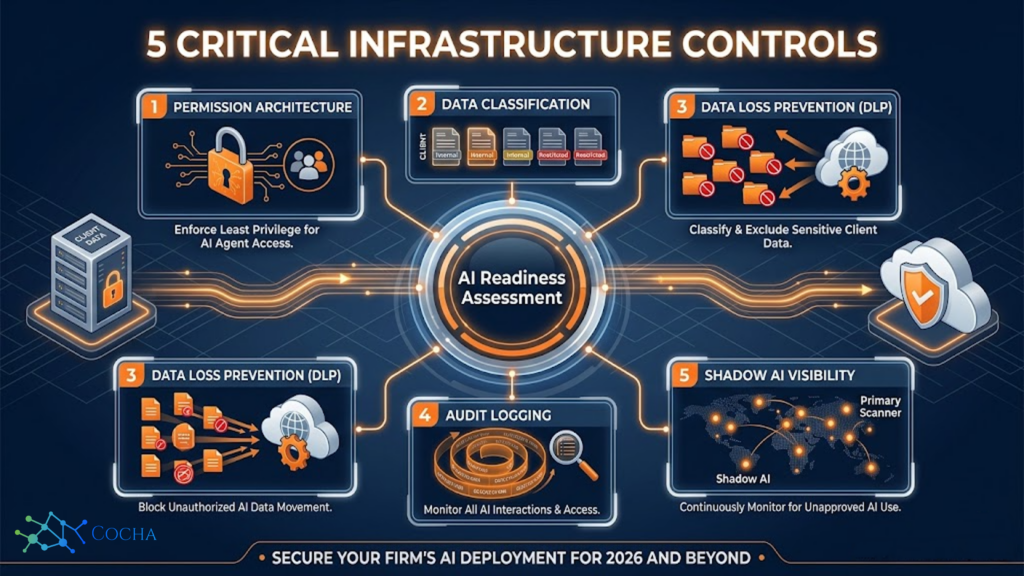
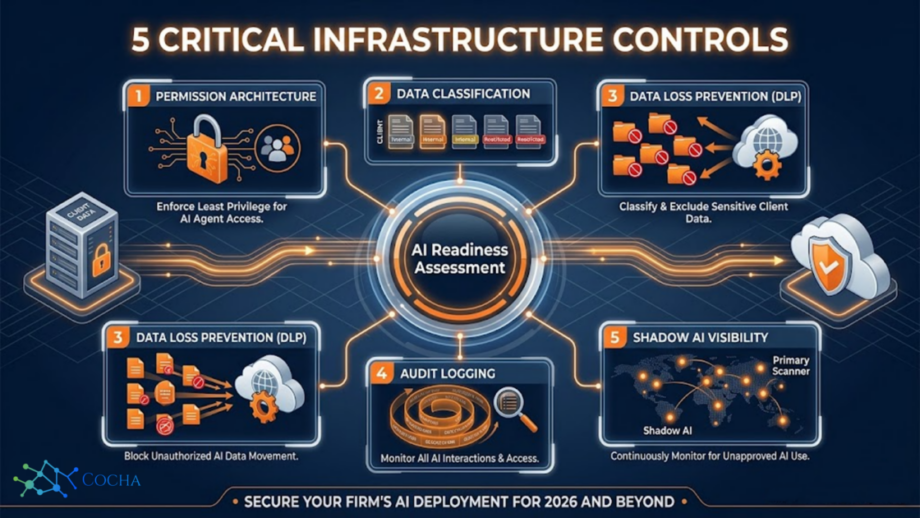
The 5 Infrastructure Controls for Law Firm AI Security
To ensure a safe deployment, our AI readiness assessment for law firms focuses on five core technical pillars. These controls act as the guardrails that keep your AI helpful rather than hazardous.
1. Permission Architecture (The "Least Privilege" Principle)
Before AI touches your data, you must enforce a “Least Privilege” model. Most firms have “permission creep,” where staff gain access to folders over years and never lose them.
Why it matters: AI will surface anything the user can “see.” If an associate has read access to a “Firm Financials” folder they shouldn’t, Copilot will gladly summarize the partner draw for them.
Without it: You risk internal data leaks that could compromise firm morale or violate client confidentiality agreements.
2. Data Classification and Labeling
Modern law firm AI security relies on sensitivity labels. You need to identify which files are “Highly Confidential,” “Internal Only,” or “Public.”
Why it matters: You can configure AI to ignore specific labels. For example, any document labeled “Top Secret” can be excluded from the AI’s training or search index.
Without it: The AI treats a casual lunch invite the same way it treats a sensitive merger and acquisition document.
3. Updated Data Loss Prevention (DLP) Policies
Legacy DLP policies usually focus on blocking credit card numbers in emails. AI requires a more nuanced approach.
Why it matters: You need policies that prevent users from “copy-pasting” sensitive blocks of text into unapproved web-based AI tools.
Without it: Your firm becomes a victim of shadow AI law firms risks, where proprietary work product ends up in a public AI’s training set.
4. Comprehensive Audit Logging
If an AI interaction occurs, you must be able to reconstruct it.
Why it matters: If a client asks, “Did your AI process my data?” you need a logged trail showing who asked the AI what, and what files the AI accessed to provide the answer.
Without it: You fail the “audit” test of professional responsibility and leave the firm vulnerable to “silent” data exfiltration.
5. Shadow AI Visibility and Shadow AI Mapping
You cannot manage what you cannot see.
Why it matters: Part of a strong AI readiness assessment for law firms involves scanning your network traffic to see which AI domains (OpenAI, Anthropic, Midjourney) your employees are visiting.
Without it: You might have 20 different employees using 20 different unmanaged AI tools, each creating a separate point of vulnerability for client-attorney privilege.
What the free Snapshot (and paid Assessment) look like
When Steve and I sit down with a firm, we aren’t there to give a sales pitch for a specific software. A free AI Readiness Snapshot is the structured review we run first. The paid Assessment is the remediation plan that follows if you want one.
We look at your Entra ID (Azure AD) configuration, your M365 tenant settings, and your existing security posture. We often combine this with an exposure snapshot to see if there are already “leaks” in your perimeter.
The process is designed to be high-impact but low-friction:
Discovery: We spend about 90 minutes with your IT lead or managing partner to understand your goals.
Analysis: We run automated scans to identify “permission bloat” and shadow AI law firms activity.
Output: You receive a prioritized gap list. We tell you exactly what to fix (e.g., “Disable legacy auth,” or “Apply labels to the X-Client folder”) before you roll out your AI tools.
If you are already moving toward a “security-first” culture, this may overlap with your zero trust assessment, which is the gold standard for modern law firm infrastructure.
Don't Let AI Be Your Firm's "Silent" Breach
Innovation is essential, but in the legal world, it cannot come at the expense of privilege. The goal of an AI readiness assessment for law firms is to give you the confidence to say “Yes” to new tools because you know your foundation is secure.
At Cocha Technology, we’ve seen how transformative AI can be for a firm’s bottom line—but only when it’s deployed with the right controls. Don’t let your firm be the cautionary tale of the associate who “asked too much” of an unguarded AI.
Recent Posts
Have Any Question?
Call or email Cocha. We can help with your cybersecurity needs!
- (281) 607-0616
- info@cochatechnology.com
About the Author:

Steve Combs
Co-Founder & Managing Director, Cocha Technology
Steven is a fractional CIO/CISO with 30+ years of enterprise IT and security leadership. He has built AI governance frameworks for organizations with 1,700+ users, led enterprise Microsoft Copilot deployments, and conducted security assessments across law firms, energy companies, financial institutions, and PE-backed manufacturers.