AI Risk Mitigation for Law Firms: The Sanctions Are Rising, and They All Say the Same Thing


Which M365 DLP tier fits a law firm already on Copilot?
January 16, 2026
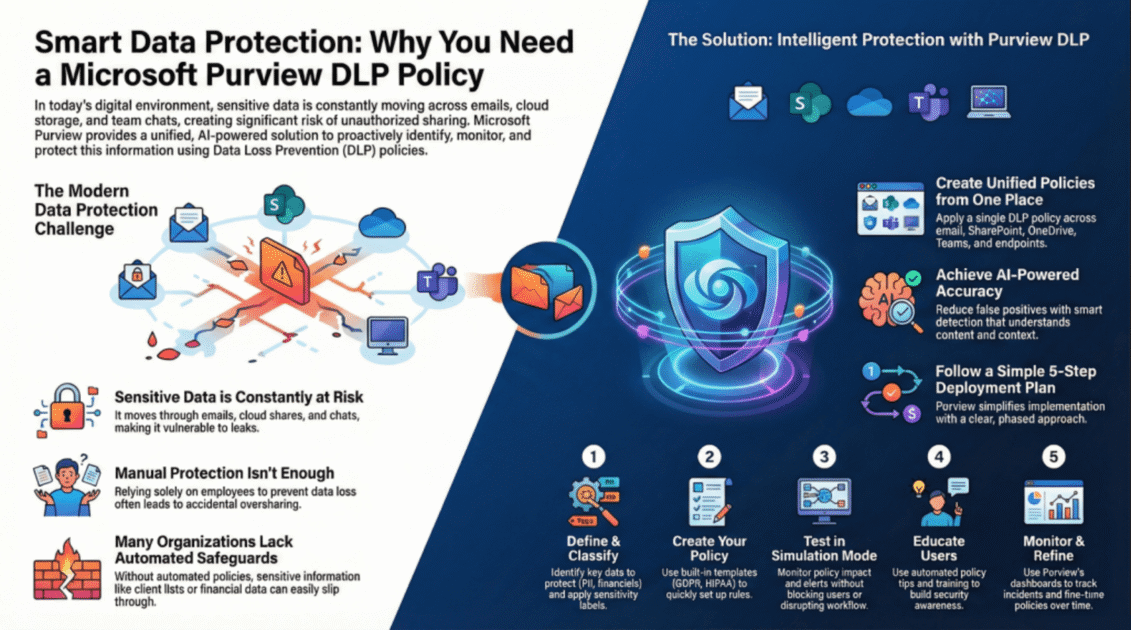
For mid-size law firms already running Copilot, DLP tier is a client-data control decision, not a generic budget line. E3, E5 Compliance, and full E5 each cover different depth for privilege, ethical walls, and what agents can reach.
A common gap: IT assumes Microsoft 365 DLP is the same across tiers. It is not. E3 sets a collaboration baseline. Modern threats and Copilot-era work often need automated labeling, deeper Purview controls, or endpoint and insider-risk tools that sit in higher tiers.
This guide helps law-firm IT match DLP depth to risk, then prove gaps with a free AI Readiness Snapshot. For SKU sourcing, see Technology Brokerage.
The E3 Foundation: Establishing the Compliance Baseline
The Microsoft 365 E3 license is a solid starting point for many mid-size law firms moving collaboration fully into the cloud.
For Microsoft 365 DLP, E3 focuses on the collaboration core: Exchange, SharePoint, and OneDrive. Admins can build policies that catch accidental sharing of sensitive patterns inside those silos. That is useful. It is often not enough once Copilot can ground on matter libraries with weak permissions.
Key Limitations of the E3 Tier
While E3 is excellent for checking the box on “compliance basics,” it leaves several strategic doors wide open:
- Manual Sensitivity Labeling: Users can apply labels to documents, but the system relies entirely on their manual decision-making.
- Perimeter Thinking: E3 is primarily focused on protecting data within the cloud boundary, offering little visibility into what happens once a file is downloaded to a local machine.
- Reactive Posture: E3 focuses on the content of the data rather than the intent of the user.
For a small to mid-market company with low-risk data, E3 may suffice. However, as organizations grow, the “manual” nature of E3 security often becomes a bottleneck for productivity and a liability for security.
The Middle Path: E5 Information Protection & Governance
For organizations that realize E3 is insufficient but aren’t ready for the full financial leap to a complete E5 suite, Microsoft offers a strategic “middle ground.” This is often referred to as the E5 Compliance or the Information Protection & Governance SKU.
This option is designed for the organization that has moved beyond simple compliance and is now focused on data governance. The shift here is from manual management to automated intelligence.
Bridging the "Manual" Gap
The most significant upgrade in this tier is automatic, service-side labeling. Rather than hoping a busy employee remembers to tag a document as “Confidential,” the system can scan content as it is created or modified and apply the correct classification automatically. This is a foundational step for any company looking to implement a modern Microsoft 365 DLP strategy, as it ensures that security policies are applied consistently across thousands of documents without human error.
Advanced Governance and Archiving
This tier also introduces advanced data lifecycle management. According to Microsoft’s official licensing guidance, the Information Protection & Governance add-on provides the tools necessary for records management and automated retention policies. This is vital for legal teams who need to ensure that data is not only protected while in use but also properly disposed of (or archived) to meet regulatory requirements.
The Full Shield: Microsoft 365 E5 and Zero Trust
The jump to a full M365 E5 license represents more than just a feature upgrade; it is a fundamental shift in security philosophy. While E3 secures the perimeter, the full E5 suite is built on Zero Trust architecture, where every identity, endpoint, and access request is continuously verified.
Solving the Endpoint Blind Spot
One of the most dangerous gaps in E3 is the lack of Endpoint DLP. Without this, your organization is blind to what users do with data on their local machines. An E5 license allows you to monitor and block high-risk activities like copying sensitive intellectual property to a USB drive or printing confidential customer lists.
Addressing Insider Risk and Intent
Perhaps the most sophisticated component of the E5 suite is Insider Risk Management. Traditional Microsoft 365 DLP looks for sensitive strings of text. Insider Risk Management looks for patterns of behavior. For example, if a disgruntled employee begins downloading an unusual volume of sensitive files and renaming them before a resignation date, E5 can flag this behavior before the data ever leaves the organization.
Securing Modern Collaboration
In the modern workplace, Teams is the hub of activity. However, E3 has notable blind spots in Teams chat and channel messages. E5 introduces advanced protection that can prevent sensitive data (like a Social Security number) from being pasted into a chat with an external contractor, stopping a potential breach in real-time.
Aligning DLP tier to law-firm risk (and Copilot)
Choosing among these options is about aligning budget to client-data and Copilot risk, not collecting features.
- E3 fits firms focused on a compliance checklist and a solid but mostly manual baseline for Exchange, SharePoint, and OneDrive.
- E5 Information Protection & Governance fits firms prioritizing data governance: automated labeling and lifecycle controls that reduce human error on matter documents.
- Full E5 fits firms that need active defense: endpoint DLP, insider risk, and tighter Teams controls when privilege exposure is high.
After you pick a tier, still prove what Copilot can reach. Licenses don’t fix oversharing. Pair this decision with Copilot readiness and the Copilot data ring-fence guide. Related: M365 licensing for law firms.
Download our Whitepaper for our technical checklist on preparing your data for Purview and contact us for your free Data Security Workshop.
Recent Posts
Have Any Question?
Call or email Cocha. We can help with your cybersecurity needs!
- (281) 607-0616
- info@cochatechnology.com
About the Author:

Steve Combs
Co-Founder & Managing Director, Cocha Technology
Steven is a fractional CIO/CISO with 30+ years of enterprise IT and security leadership. He has built AI governance frameworks for organizations with 1,700+ users, led enterprise Microsoft Copilot deployments, and conducted security assessments across law firms, energy companies, financial institutions, and PE-backed manufacturers.