8 Governance Controls to Turn on Before a Grok Bot Touches Your Portfolio Company’s Deal Data


AI Risk Mitigation for Law Firms: 3 Laws Reshaping the Landscape
July 29, 2026
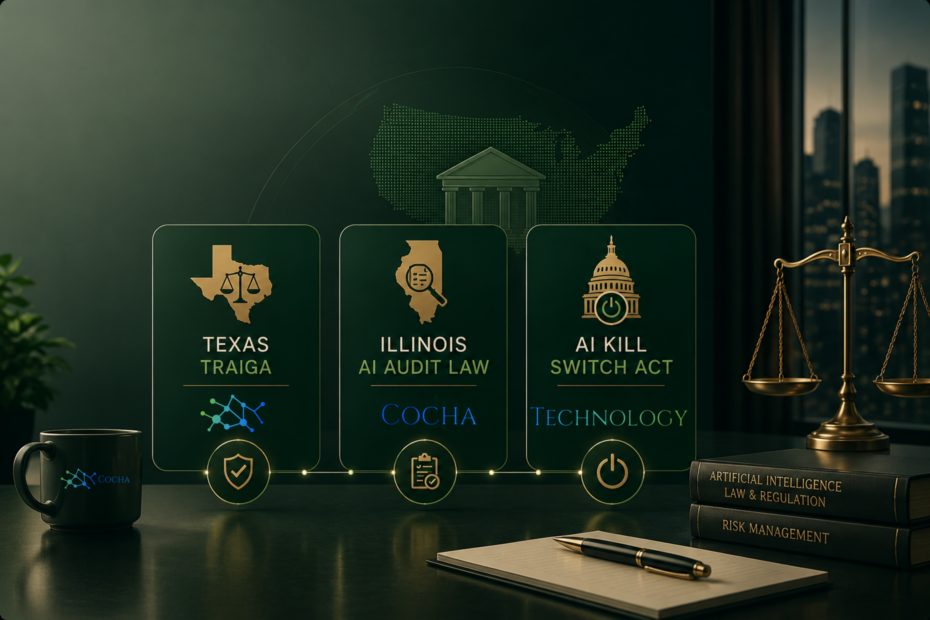
Three weeks ago, a general counsel asking “what AI law actually applies to us” had a fairly short answer. Not anymore. In the span of about two weeks, Illinois signed the first law in the country requiring frontier AI developers to get independent audits, and two members of Congress introduced a bill that would let a federal agency order AI systems shut down entirely. Both landed on top of a Texas law that has already been in force since January 1.
If you’re doing AI risk mitigation for law firms right now, and not just for your own practice but for the clients asking what all this means, you’re suddenly juggling three different regulatory philosophies at once. One state casts a wide net with a light touch. Another casts a narrow net with real teeth. And a federal proposal, if it ever passes, changes the conversation entirely.
Here’s what’s actually in each one, where they pull in different directions, and what AI risk mitigation for law firms should look like once you’re tracking all three at the same time.
Texas AI Law: What TRAIGA Already Requires
Texas’s Responsible AI Governance Act, TRAIGA for short, is the Texas AI law that took effect January 1, 2026. It’s worth starting here, because it’s the one law of the three that’s actually live right now, not a proposal or a future deadline. Any conversation about AI risk mitigation for law firms with Texas ties has to start with what’s already enforceable today.
TRAIGA doesn’t try to regulate AI systems generally. It targets intent. The law prohibits developing or deploying AI for a specific list of bad purposes: manipulating behavior in harmful ways, unlawful discrimination, generating deepfakes or child exploitation material, or infringing constitutional rights. If you can’t show intent to misuse the system for one of those purposes, you’re largely outside the law’s reach.
What makes TRAIGA distinct, and what I think gets underplayed in a lot of the coverage, is how wide the net is. It applies to basically anyone doing business in Texas, offering a product or service to a Texas resident, or deploying AI inside the state. Out of state companies, international companies, doesn’t matter. If a Texan can use it, TRAIGA can reach it.
The tradeoff is that the obligations, once you’re caught, are relatively contained. There’s no audit requirement. Enforcement sits exclusively with the Texas Attorney General, there’s no private right of action, and companies get a sixty-day cure period before penalties kick in. Fines run from roughly $80,000 to $200,000 per violation after that window closes. Companies that can show substantial alignment with the NIST AI Risk Management Framework get something close to a safe harbor.
So: broad reach, light obligations, one enforcer, a cure period, and a clear path to lowering exposure through a recognized framework. That’s the Texas model, and it’s the baseline every other AI risk mitigation for law firms’ conversation in this piece gets measured against.
Illinois AI Audit Law: Raising the Bar
Illinois took almost the opposite approach. Governor Pritzker signed the Artificial Intelligence Safety Measures Act on July 6, 2026, and this new Illinois AI audit law is the first in the country to require large frontier AI developers to bring in an independent third party to audit their compliance every year, not just disclose what they’re doing and hope regulators believe them.
The scope here is narrow by design. It only reaches “large frontier developers,” defined as companies with more than $500 million in annual revenue whose models are trained past a specific compute threshold. Your firm almost certainly isn’t one of these companies. But the clients you have who build or deploy frontier models, or who license them under contracts that pass obligations downstream, need to know this is coming. This is where AI risk mitigation for law firms stops being about your own tools and starts being about advising someone else’s.
The obligations, once the law fully phases in, are heavy. Large frontier developers have to publish a frontier AI framework describing how they manage catastrophic risk, file a transparency report before deploying a new or materially changed model, report critical safety incidents within 72 hours (24 hours if there’s imminent risk of death or injury), and retain independent audit reports for the life of the model plus five years. Penalties run up to $1 million for a first violation and $3 million for each one after that.
Here’s the part worth sitting with for a second: none of the audit or framework requirements actually bite until January 1, 2028. Illinois gave developers real runway. What that means practically, for anyone doing AI risk mitigation for law firms with frontier developer clients, is that this is a law to start planning against now, while the deadline still feels far off, not a fire drill to run once it’s imminent.
Congress's AI Kill Switch Act Adds a Federal Wildcard
The third piece isn’t law yet, and might never be, but it’s worth tracking closely. On July 23, Representatives Ted Lieu and Nathaniel Moran introduced the AI Kill Switch Act. It would give the Secretary of Homeland Security authority to order a slowdown, or a complete shutdown, of an AI system found to pose catastrophic risk.
It applies to developers with at least $500 million in annual AI revenue, the same threshold Illinois uses for its “large frontier developer” definition. That’s probably not a coincidence. It suggests $500 million in AI revenue is becoming the de facto line regulators reach for when they want to describe “big enough to worry about.” Watch for that number to show up again in other state bills over the next year. I’d bet on it.
Noncompliance under the bill would carry fines of up to $20 million per day. Per day, not per violation. That’s a number designed to make ignoring a shutdown order financially irrational even for the largest labs.
Whether this bill goes anywhere is genuinely unclear, plenty of ambitious AI legislation has stalled in Congress before. But bipartisan sponsorship on an AI safety bill is not nothing, and it tells you where at least part of the federal conversation is heading toward giving an executive agency real-time authority over frontier systems, not just after the fact enforcement power. Anyone responsible for AI risk mitigation for law firms with clients in defense, healthcare, or critical infrastructure should be watching this one closely, since those are exactly the sectors a “catastrophic risk” standard tends to sweep in first.
What the Patchwork Actually Means for Your Firm
Lay these three next to each other and a pattern shows up. Texas regulates broadly and lightly: almost everyone’s in scope, but the bar to clear is mostly about intent and having a recognized framework in place. Illinois and the proposed federal law both regulate narrowly and heavily: only the biggest frontier developers are in scope, but once you’re there, the obligations (audits, frameworks, incident reporting, and now potentially a literal off switch) are serious.
For most firms, AI risk mitigation for law firms isn’t about worrying whether your firm itself counts as a large frontier developer. It doesn’t. It’s about two other things.
First, client advisory work just got more layered. A client operating in Texas needs a TRAIGA compliant intent and misuse policy today. A client that happens to be, or works closely with, a large frontier developer needs to start building toward Illinois’s 2028 audit requirement now and should be watching the Kill Switch Act closely given how fast a bill like this could move if there’s a high-profile AI incident in the news. Good AI risk mitigation for law firms means knowing which of these three regimes actually touches a given client, instead of treating all AI regulation as one undifferentiated blob.
Second, and this is the one firms skip; your own vendor relationships sit inside this same web. When you evaluate a legal AI tool, or renew a contract with one, you’re implicitly relying on that vendor’s compliance posture across every one of these regimes. If a vendor can’t tell you plainly where they stand on TRAIGA’s NIST alignment or Illinois’s audit trajectory, that’s useful information about how seriously they take governance generally, not just this one rule. AI risk mitigation for law firms must include the tools sitting inside the firm, not only the advice going out the door.
How to Get Ahead of the Patchwork
A few practical moves, roughly in order of urgency, for firms that want AI risk mitigation to mean something rather than sitting in a memo nobody reopens:
- Start with your intake. If your firm has any presence in Texas, or clients who do, confirm your own AI tools and any client facing AI features don’t touch TRAIGA’s prohibited use categories. This is the live obligation right now, not a future one, and it’s the fastest win available.
- Then build a tracking habit. New state AI bills are landing at a pace that makes a one-time review pointless. The $500 million revenue threshold showing up in both Illinois and the federal bill is worth flagging to clients specifically, since it may become the model other states copy next.
- Then look at your vendor contracts. Ask your AI tool vendors directly where they stand on NIST AI RMF alignment and whether they’d qualify as a large frontier developer under Illinois’s definition. Their answer, or their inability to answer, tells you something about how seriously they’ve taken AI risk mitigation on their own end.
Pair that with a look at our breakdown of your firm’s biggest AI risk. And if Copilot or another agentic tool is already in your stack, our guide to Microsoft Copilot governance for law firms is worth a read too, since a lot of this regulatory pressure lands squarely on however your firm governs the AI tools it’s already using.
The Bottom Line
Three different governments, three different theories of how to regulate AI, and all three are relevant to a law firm’s risk posture at the same time.
- Texas says: watch your intent, broadly.
- Illinois says: if you’re big enough, prove it with an audit.
- Congress, if this bill moves, says: we want the ability to turn it off.
AI risk mitigation for law firms used to mean tracking one or two headline laws. Now it means holding three different regulatory logics in your head at once, and knowing which one applies to which client, which vendor, and which use case. That’s not a one-time project. It’s a standing one, and the firms that treat it that way are the ones that won’t get caught flat footed when the next state legislature picks up a pen.
Not sure where your firm actually stands against any of these three frameworks? Start with Cocha Technology’s AI Readiness Assessment and get a clear picture before a client, or a regulator, asks first.
Recent Posts
Have Any Question?
Call or email Cocha. We can help with your cybersecurity needs!
- (281) 607-0616
- info@cochatechnology.com
About the Author:

Steve Combs
Co-Founder & Managing Director, Cocha Technology
Steven is a fractional CIO/CISO with 30+ years of enterprise IT and security leadership. He has built AI governance frameworks for organizations with 1,700+ users, led enterprise Microsoft Copilot deployments, and conducted security assessments across law firms, energy companies, financial institutions, and PE-backed manufacturers.