Misconfigured Storage in Azure: Why One Public Blob Puts Your Entire Tenant at Risk
June 26, 2026
Back in late 2023, security researchers uncovered a massive data exposure incident that shook the tech world: a misconfigured storage bucket exposed a staggering 38 terabytes of private corporate information, including passwords, secret keys, and internal communication logs. The twist? The data belonged to Microsoft’s own internal AI research team.
If the very engineers who architected the cloud platform can accidentally leave the digital back door completely unlocked, it is a mathematical certainty that it is happening inside your environment right now.
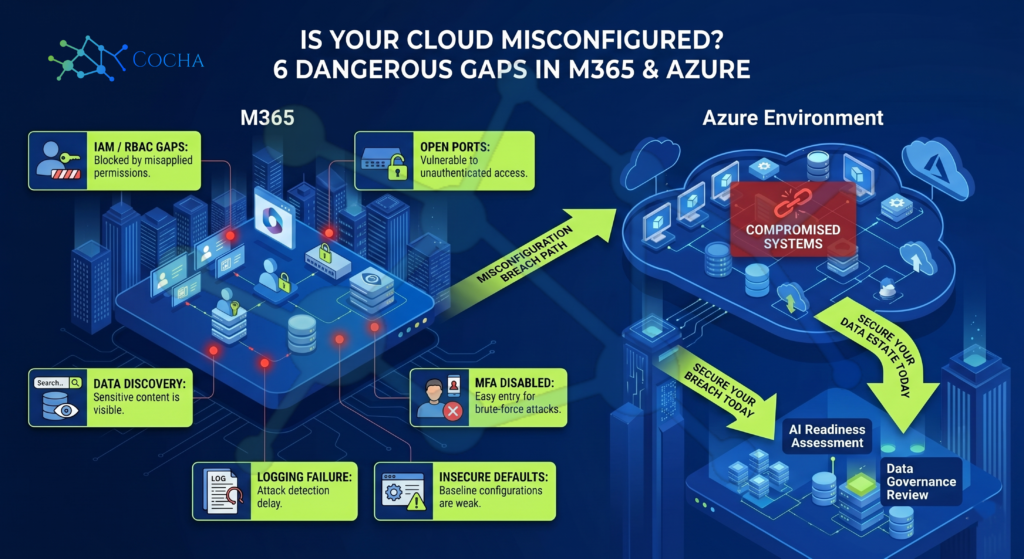
At Cocha Technology, we scan cloud networks every single week, and a misconfigured storage account remains one of our most frequent discoveries. When an organization falls victim to modern cloud misconfiguration breaches, it is rarely because a highly sophisticated threat actor bypasses their high-end firewalls. Instead, a simple operational blind spot allowed a single public storage bucket to jeopardize their entire technical footprint.
Why Azure Storage Is the Most Common Misconfiguration Finding
Azure Blob Storage is an incredibly powerful, versatile tool. It serves as the primary engine room for storing bulk corporate assets, automated database backups, systemic exports, and temporary setup folders.
By default, Microsoft configures new Azure storage accounts to reject anonymous public access. The exposure occurs when engineering teams actively modify these boundaries to solve a temporary workspace challenge.
Why do these cloud security misconfigurations happen so frequently across growing business networks?
- The Convenience Trap: A developer needs to quickly share a large log file or database extract with an external partner. Rather than managing complex identity controls or shared access signatures, they simply flip the container’s access policy to “Public” to get the job done quickly, intending to turn it off later. They almost always forget.
- Migration and Testing Artifacts: During complex infrastructure shifts or software testing phases, teams create dozens of temporary storage accounts. When the project finishes, these accounts sit abandoned, unmonitored, and completely unreviewed.
- Lack of Visibility: Because the underlying virtual machines and core corporate applications continue to run perfectly, there is no technical alert or flashing red dashboard warning that tells your IT team a specific repository is sitting open to the public web.
The most critical vulnerabilities are rarely the ones your team actively manages; they are the ghost assets that nobody remembers creating.
What Exposure Looks Like in Practical Terms
When a storage blob is set to allow public access, it means any user or script on the internet that targets the specific URL endpoint can instantly read and download those files. There is no password prompt, no multi-factor authentication check, and no identity validation standing in the way.
Many business owners assume that because their container URLs are long and randomized, an outside threat actor could never guess the exact path to find their data. This is a highly dangerous misconception.
In reality, executing cloud misconfiguration breaches does not require an advanced hacking script. It is as simple as a coordinated search:
- Automated Network Scanners: Malicious bots continuously scan the entire IPv4 address space, targeting common cloud naming patterns like .blob.core.windows.net to map open entry points.
- Search Engine Indexing: If a public link to your asset is ever clicked or shared in an indexed forum, public search engines will log the path, making your corporate backups searchable by anyone with basic query skills.
- Common Target Targets: When these automated scanners identify an open repository, they explicitly hunt for file names containing words like backup.sql, config.json, credentials.txt, salary_2025.xlsx, or web.config.
Why One Open Blob Can Cascade Across Your Entire Network
The true danger of a misconfigured storage account isn’t just the loss of the specific files sitting inside that individual container. The real threat is the structural cascade effect.
A single exposed repository rarely exists in complete isolation. When a container holds system configurations, developer scripts, or old virtual machine snapshots, it frequently contains hardcoded connection strings, third-party API keys, and administrative login credentials.
If an attacker downloads a configuration file containing service principal credentials for Microsoft Entra ID, they immediately gain the power to authenticate as a trusted application directly inside your tenant. From there, they can move horizontally across your network:
- Accessing live production SQL databases.
- Reading confidential executive emails.
- Creating new, highly privileged user accounts to maintain permanent access.
- Deploying ransomware across your entire active server fleet.
The blast radius of a single overlooked storage setting is almost always significantly larger than the initial finding itself, turning a minor mistake into an institutional data crisis. According to tracking metrics from the CISA Cloud Security Technical Reference Guide, unmanaged resource permissions are the leading catalyst for lateral movement inside compromised corporate tenants.
What a Cloud Exposure Snapshot Checks
You cannot secure or fix an infrastructure gap that your technical leadership hasn’t actively measured. If you want to protect your perimeter from devastating cloud security misconfigurations, you must stop relying on assumptions and evaluate your architecture against verified benchmarks.
At Cocha Technology, we treat a security checkup as a highly streamlined, engineering-focused process. Our targeted Exposure Snapshot uses advanced scanning tools to inspect your environment’s metadata, highlighting your vulnerabilities before an outside scanner finds them.
Our assessment checks four core operational layers:
- Comprehensive Storage Audit: We evaluate every single storage account across your footprint, analyzing public access parameters, data-at-rest encryption status, and soft-delete configurations to ensure your history can’t be easily erased by an attacker.
- Entra ID Verification: We analyze your service principal roles and application permissions, identifying over-permissive identities that could allow an attacker to execute lateral movement.
- Role Assignment Analysis: We review every user profile holding access to your data, ensuring your business enforces a strict “Least Privilege” model. For organizations looking to protect endpoints, this ties directly into our standard zero-trust agent deployment methodologies.
- Network Rule Configurations: We check whether your storage environments are restricted to specific virtual networks (VNets) or known corporate IP ranges, ensuring your data never touches the open internet.
The final deliverable is not a generic automated printout. You receive a precise technical report alongside a live, engineer-led readout session detailing exactly what checkboxes to modify and what policies to apply to guarantee your tenant is completely locked down against cloud misconfiguration agent security risks.
Take Control of Your Cloud Boundaries
Your cloud environment should be an asset that drives your business efficiency forward, not a quiet point of vulnerability for your corporate data. By addressing your network’s misconfigured storage points today, you eliminate the simple, everyday shortcuts that lead to the majority of modern network exposures.
Don’t wait for a data discovery incident or a costly compliance audit to show you where your configurations are failing. Steve and the engineering team at Cocha Technology are ready to help you evaluate your network rules, harden your storage perimeters, and ensure your entire cloud footprint is genuinely secure.
Protect Your Network Today
Ready to see where your Azure configurations actually stand? Let’s verify your boundaries together. Contact us today to schedule your formal Exposure Snapshot and guarantee your digital doors are completely locked.
Recent Posts
Have Any Question?
Call or email Cocha. We can help with your cybersecurity needs!
- (281) 607-0616
- info@cochatechnology.com
About the Author:

Steve Combs
Co-Founder & Managing Director, Cocha Technology
Steven is a fractional CIO/CISO with 30+ years of enterprise IT and security leadership. He has built AI governance frameworks for organizations with 1,700+ users, led enterprise Microsoft Copilot deployments, and conducted security assessments across law firms, energy companies, financial institutions, and PE-backed manufacturers.