
Microsoft 365 E3 vs E5 vs E7: Which License Does Your Firm Need for Copilot?
August 12, 2026
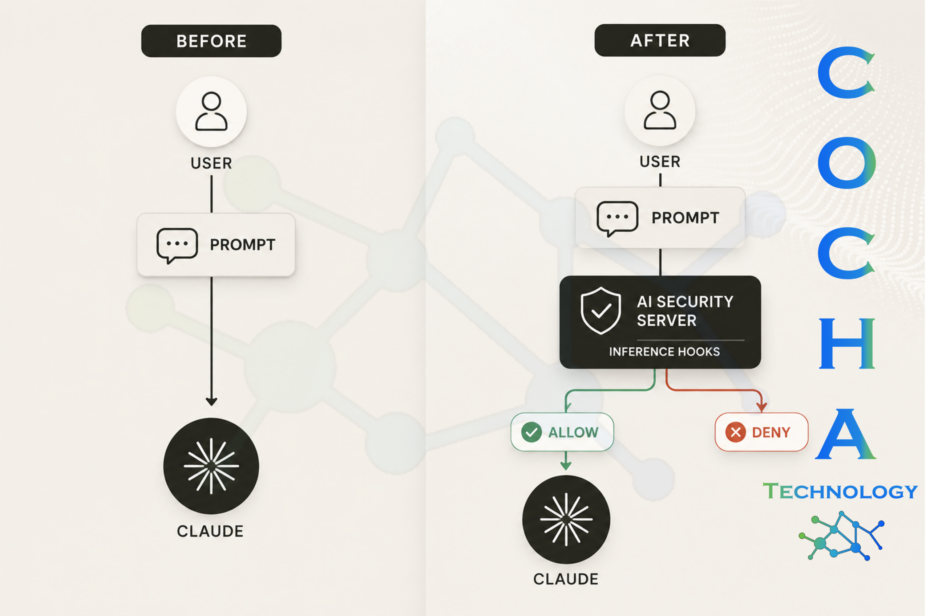
Somewhere in your firm right now, an associate is probably pasting something into an AI tool that shouldn’t leave the building. Not out of carelessness, most of the time. Just because nothing stopped them.
That’s the gap Anthropic just took a real swing at closing. On August 5, 2026, the company launched inference hooks in beta for Claude Enterprise, a feature that routes every prompt and every tool call through an organization’s own security server for a verdict, allow or deny, before Claude ever processes a word of it. A denied request never reaches the model. Not redacted, not flagged after the fact. Blocked.
I think this is worth sitting with for a second, because inference hooks are a genuinely different kind of control than what most firms have relied on so far.
Here’s the mechanism, stripped down. When someone submits a prompt inside Claude Enterprise, be it chat, Claude Code, Claude Cowork, wherever, Anthropic sends the conversation transcript to your organization’s own security server before inference runs. That server, an HTTPS service your firm or your security vendor operates, checks the content and sends back a verdict. Allow, the request proceeds. Deny, it stops there.
Anthropic’s own announcement frames data loss prevention as the headline use case for inference hooks, and that tracks. But the platform documentation three other paths built on the same plumbing: real time transcript archival as a push-based alternative to polling Anthropic’s Compliance API, prompt telemetry captured the moment a tool gets used, and custom policy engines, things like model allowlists or restricting certain projects to certain data classifications.
None of that is flashy. It’s plumbing. But plumbing is exactly what’s been missing.
Picture a paralegal working an M&A due diligence project, moving fast, pulling from a shared drive full of target company documents. One file has an unredacted employee roster with Social Security numbers sitting in a column nobody scrubbed yet. The paralegal pastes a chunk of it into Claude to ask for a quick summary.
Without inference hooks, that request just goes through. The model sees the data, processes it, and the only backstop is whatever the paralegal remembers from a training session eight months ago.
With inference hooks configured, the firm’s security server inspects that transcript first. If the rule set flags Social Security numbers as a blocked category, the request gets denied before Claude ever reads it. The paralegal gets an error instead of a summary, and someone in IT or compliance can see exactly what got stopped and why.
That’s the whole shift in one scenario. Not smarter judgment from the model. A checkpoint in front of it.
Most law firm AI use policies today are written instructions. Don’t paste privileged material into a consumer chatbot. Don’t upload client documents to unapproved tools. Good policies, often well written, sitting in a binder or an intranet page, enforced entirely by whether the person reading them decides to follow them that day.
We’ve argued before that this is a real problem, not a theoretical one. Our piece on why DLP won’t protect agents on its own walked through why traditional data loss prevention tools, built for email and file shares, mostly can’t see what’s happening inside an AI conversation at all. The content isn’t leaving through a monitored channel. It’s just typed into a box.
Inference hooks change that math, at least for firms using Claude Enterprise. Now there’s a technical checkpoint that sits in front of the model itself, not behind it, not bolted onto a network perimeter that AI traffic quietly routes around. A firm can write a rule, feed it into their own security server, and actually stop a prompt containing, say, a client’s Social Security number or an unredacted settlement figure before Claude ever sees it. That’s a meaningfully different claim than “we trained everyone not to do that.”
To put these AI DLP controls in context, compare how Claude and Copilot handle firm data.
I’d be doing this post a disservice if I made this sound like a finished product. It isn’t, and the limits are worth knowing before anyone gets too excited in a pitch meeting.
Verdicts are binary right now. The security server can allow or deny, but it can’t rewrite or redact a prompt on the fly. If a document has one sensitive line buried in an otherwise fine request, the whole thing gets blocked rather than scrubbed and passed through. That’s a blunt instrument, and blunt instruments create friction that pushes people toward workarounds if a firm isn’t careful about tuning the rules.
The other limit: only prompt side enforcement exists at launch. Anthropic has said response side checking, verifying what Claude sends back rather than just what goes in, is planned as a later event, not something available today. So, inference hooks close the leak on the way in right now. They don’t yet watch what comes out.
Worth saying plainly: this is a beta feature for Claude Enterprise specifically, not something every AI tool in your stack has, and it requires your firm or a vendor to stand up and maintain that security server. This isn't a switch you flip. It's infrastructure someone must build and own, and that ownership question matters more than the feature announcement itself for most firms.
Here’s a wrinkle worth knowing about. Thomson Reuters rebuilt the next generation of CoCounsel Legal on Anthropic’s Claude Agent SDK, general availability planned for this month. Which means a firm using CoCounsel isn’t necessarily outside Claude’s reach the way it might assume. Depending on how a vendor has its own enterprise agreement structured, some of this governance plumbing may extend into tools that don’t say “Claude” anywhere on the login screen.
There is a question worth putting directly to any legal AI vendor built on Claude underneath: does inference hooks style enforcement apply to what we’re using, or does it stop at Anthropic’s own consumer facing product? The honest answer, for most vendors right now, is probably “we’re still figuring that out.” It’s worth asking anyway.
If your firm has been treating AI governance as mostly a training and policy exercise, this is a nudge toward something more concrete. We’ve written about AI agent security for law firms before, and the throughline across a lot of that work is the same idea showing up again here: policies matter, but they’re not controls. A control is something that still works when a person forgets, or rushes, or decides the rule doesn’t apply just this once.
There’s also a client facing angle here that shouldn’t get buried. Clients, particularly ones in regulated industries, are starting to ask firms pointed questions about how AI tools handle their data. “We have a policy” is a weaker answer than “we have a technical control that blocks certain categories of data from reaching the model, and here’s how it’s configured.” Malpractice insurers and bar regulators are heading the same direction. Evidence of enforcement, not just intent, is going to matter more over the next year, not less.
None of this replaces the broader work of AI risk mitigation for a law firm. We’ve covered that ground in more depth in [our piece on where a firm’s biggest AI risk actually sits, and inference hooks are one piece of a much bigger picture, not a substitute for the rest of it. But it’s a genuinely useful piece, and one that didn’t exist a week ago.
A few honest questions worth asking internally before this goes anywhere near a client conversation.
Anthropic didn’t fix AI governance for law firms with this release. What it did was hand firms a real tool for a problem that’s been mostly theoretical until now. Worth using it. Worth knowing exactly where its edges are too.
If you’re not sure what client data is currently reachable by the AI tools your team uses day to day, or which of them have any real checkpoint in front of them, that’s worth finding out before a client or a regulator asks first. Our Zero Trust Assessment looks at exactly this, what your AI tools and agents can actually access versus what they should, and gives you a clear, specific picture of where the real gaps sit.
Call or email Cocha. We can help with your cybersecurity needs!
About the Author:

Co-Founder & Managing Director, Cocha Technology
Steven is a fractional CIO/CISO with 30+ years of enterprise IT and security leadership. He has built AI governance frameworks for organizations with 1,700+ users, led enterprise Microsoft Copilot deployments, and conducted security assessments across law firms, energy companies, financial institutions, and PE-backed manufacturers.