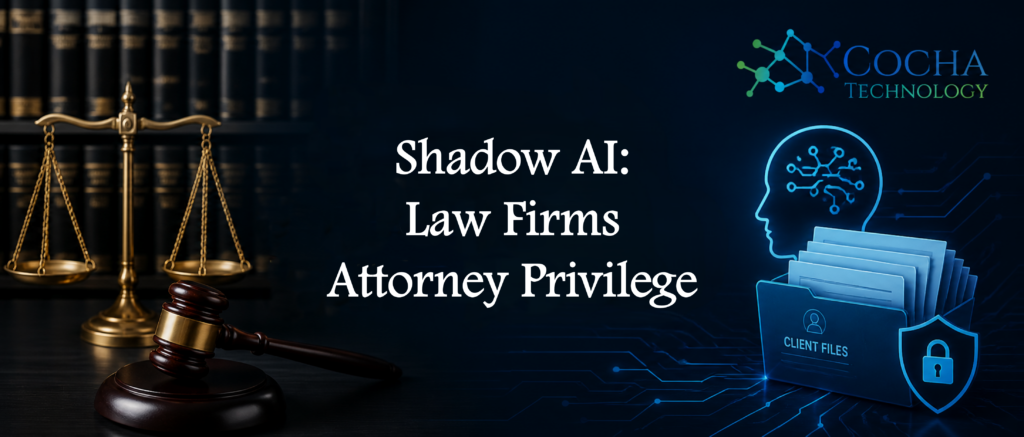
Shadow AI Law Firms Attorney Privilege: 3 Negative Risks for Your Practice
May 8, 2026
In our thirty years of consulting for professional services, we’ve seen law firms handle some of the most sensitive data on the planet. I remember the transition from “paper rooms” to encrypted servers, where the primary fear was a physical break-in or a lost laptop. But as we navigate 2026, the threat has shifted from the physical to the “Agentic.”
We recently spoke with a managing partner at a prestigious firm who told us a story that should keep every General Counsel awake at night. A senior associate, brilliant and tech-savvy, wanted to speed up the discovery process for a massive litigation case. Without consulting IT, he used a “helpful” AI tool to build a custom agent. He fed that agent three years of client files—depositions, private correspondence, and strategic memos—to “train” it to find inconsistencies in the opposing counsel’s arguments.
It worked. The agent was brilliant. But then, the other shoe dropped. Because that tool was a public-facing Shadow AI, those files became part of the model’s training data. That data was reviewed, retained, and used to shape how the model responds going forward. Weeks later, a competitor using the same tool began receiving responses that reflected the firm’s litigation strategy, framing, and argumentation patterns in ways that should have been impossible without access to those files. The firm had no way to know what the model had learned, no way to audit it, and no way to get it back. This is the nightmare of shadow AI law firm’s attorney privilege leaks.
The Death of Attorney-Client Privilege in the Cloud
The core of the legal profession is privilege. Under ABA Model Rule 1.6, attorneys have a fundamental duty to maintain the confidentiality of information relating to the representation of a client. When you or your staff use shadow AI law firm’s attorney privilege tools, you are creating a serious and defensible argument that privilege has been waived.
Most public AI models operate on a “give to get” basis. To get the insights, you must provide the data. If that data isn’t behind a “Ring Fence,” it is considered “disclosed” to a third party. In a court of law, that disclosure can be used by opposing counsel to argue that privilege has been waived entirely. In July 2024, the ABA issued Formal Opinion 512, its first formal ethics guidance on generative AI, warning that self-learning AI tools create direct risks that confidential client information will be disclosed to others, and that attorneys must obtain informed client consent before inputting any client information into such a tool.
The Hallucination Liability: When the Agent Lies to the Court
We’ve all heard the cautionary tales of attorneys citing non-existent cases generated by AI, a phenomenon that has already led to public embarrassment and judicial sanctions. But the risk of shadow AI law firm’s attorney privilege goes much deeper than just “fake cases.” The real danger lies in “Shadow Data.” When an associate trains an autonomous agent on unverified, outdated, or “scraped” data from the public web, the agent doesn’t just learn; it develops a skewed “bias” or “hallucinates” complex facts based on the noise in its training set.
In the legal world, accuracy is not just a goal. It is a non-negotiable requirement of the Bar. If your firm submits a filing or a strategic recommendation based on AI-generated research that contains a fundamental error, perhaps a misinterpreted statute or a hallucinated piece of evidence, relying on an AI tool as your defense creates serious ethical and professional exposure. The Bar is already signaling that supervising attorney responsibility does not disappear because a machine produced the output. Firms that have spent decades building reputations for precision are one unsupervised AI error away from a sanctions filing or a malpractice conversation they did not see coming.
When you allow unmanaged AI to touch your casework, you are effectively delegating your license to a black box. This is why an Exposure Snapshot is critical. You need to know if your team is relying on “Shadow” logic that could lead to a malpractice suit or a Rule 11 sanction. Resilience for the modern firm means ensuring that every piece of AI-generated output is born from a siloed, verified data set that the firm owns and controls entirely.
✦ The “Invisible” Associate: Consider a firm that prides itself on its air-gapped vault for high-profile client data. What they may not know is that their paralegals are using a browser extension that summarizes PDFs by sending them to a third-party AI. They are not trying to be malicious. They are just trying to get home in time for dinner. In a scenario like this, hundreds of confidential documents could be summarized by a server in a jurisdiction with zero data protection laws before anyone in IT knows it is happening. That is why visibility is the first step of security.
Identity Theft and the "Firm Persona"
One of the most insidious risks of shadow AI law firm’s attorney privilege is the ability for AI to mimic an attorney’s unique professional voice with frightening accuracy. When an associate or partner uses a Shadow AI tool to draft emails, briefs, or client advisories, they aren’t just getting a shortcut; they are handing over a “biometric” digital fingerprint of their writing style. These models are designed to learn cadence, vocabulary, and even the subtle rhetorical flourishes that make an attorney’s advice recognizable and trusted.
If that Shadow AI platform is breached—or if the tool’s developers sell metadata to third parties—an attacker can gain access to that linguistic profile. We are moving into an era of “Linguistic Deepfakes,” where a bad actor can use a fine-tuned model of an attorney to send convincing, fraudulent instructions to high-value clients or financial institutions. In my thirty years in IT, I’ve seen phishing evolve from poorly spelled emails to sophisticated social engineering. This is the next frontier: an email that looks, sounds, and “feels” like it came from the Managing Partner, directing a client to wire settlement funds to a compromised account. Without siloing your firm’s communication patterns within a secure environment, you are essentially training your own replacement—or worse, a digital imposter.
Protecting Your Practice with Shadow AI Protection
You cannot manage what you cannot see. At Cocha Technology, we provide the Shadow AI Protection you need to see exactly which tools are being used across your network. We don’t just block AI; we help you implement “Sanctioned AI” that keeps your data siloed and secure.
The first step is understanding your firm’s current level of risk. This is why we offer an Exposure Snapshot. This high-impact audit shows you exactly where your client data is leaking and which “Shadow” agents are currently “learning” from your files. We use technical siloing to ensure that your firm’s intellectual property stays where it belongs: inside your firm.
Trust No Agent, Verify Every Prompt
The “Attorney Who Trained an Agent” is no longer a ghost story; it’s a reality in firms across the country. In 2026, resilience means realizing that your “Digital Assistants” are often your biggest security “Leaks.”
At Cocha Technology, we combine 30 years of IT veteran experience with the zero-trust protocols your firm needs to stay compliant and protected. Don’t let shadow AI law firm’s attorney privilege be the reason you lose your next case—or your license.
Is your client data training someone else’s AI? Get your Exposure Snapshot today and secure your firm’s future.
Recent Posts
Have Any Question?
Call or email Cocha. We can help with your cybersecurity needs!
- (281) 607-0616
- info@cochatechnology.com
Author:

Steve Combs
Co-Founder & Managing Director,
Cocha Technology
Steven is a fractional CIO/CISO with 30+ years of enterprise IT and security leadership. He has built AI governance frameworks for organizations with 1,700+ users, led enterprise Microsoft Copilot deployments, and conducted security assessments across law firms, energy companies, financial institutions, and PE-backed manufacturers.