

How to ring-fence Copilot data: seven steps after you buy the licenses
May 15, 2026
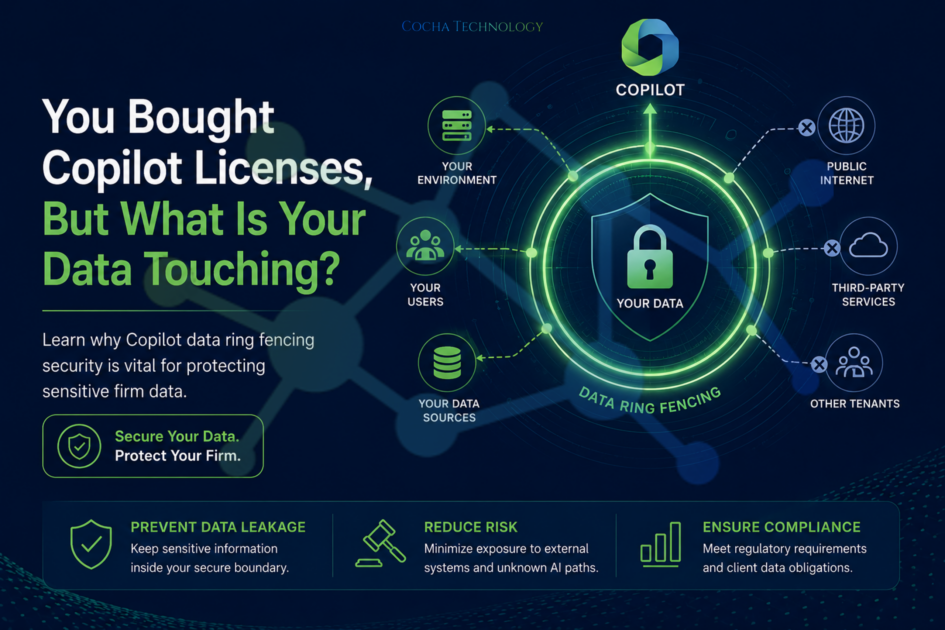
You bought Copilot. This guide is the how-to for ring-fencing it so matter files stay out of reach—not a Snapshot landing page. For law firms that turned Copilot on in 2024–25, that usually means re-deploy and harden: tighten sharing, DLP, and identity, then prove the perimeter. When you are ready to verify, book a free AI Readiness Snapshot or a permissions-first Exposure Snapshot.
The Illusion of Automatic Safety
Many leaders assume that because Copilot lives within the Microsoft 365 ecosystem, it is inherently “safe.” While Microsoft provides robust enterprise-grade protections, Copilot is only as secure as the permissions you’ve already set—or neglected. If an associate has access to a folder they shouldn’t, Copilot has access to it too.
At Cocha Technology, we’ve seen this play out in real-time. I recently spoke with a partner at a mid-sized law firm who was horrified to discover that a junior intern could use Copilot to summarize “all partner compensation files.” Why? Because those files were sitting in a SharePoint folder with “Everyone except external users” permissions. This is where Copilot data ring fencing security moves from a technical checkbox to a business necessity.
1. Establishing a Copilot Data Ring Fencing Security Perimeter
The first step in any successful deployment is defining the boundary. In a PE-backed environment, you are often dealing with cross-portfolio data that must remain strictly isolated. Without a “ring fence,” the AI might inadvertently surface insights from “Company A” while an analyst is working on a report for “Company B.”
A professional Copilot Readiness review identifies these overlap risks before the first prompt is ever written. We look for “Ghost Permissions”—access rights granted years ago that are still active today—and shut them down.
2. The Danger of "Over-Sharing" in Law and PE
In the legal sector, attorney-client privilege is the bedrock of the profession. According to a recent study by Gartner, by 2026, 75% of organizations will ignore the “over-sharing” risks of generative AI, leading to significant data leaks.
If a paralegal asks Copilot to “summarize the last three months of meeting notes for Client X,” and those notes happen to contain privileged data from Client Y because of a shared folder structure, you have a major compliance breach on your hands. Effective Copilot data ring fencing security involves auditing your Siloing of data to ensure that client matters are physically and logically separated within your tenant.
If you want a live read on open permissions, book a free Exposure Snapshot.
3. Implementing Data Loss Prevention (DLP)
You cannot manage what you cannot see. Our approach to DLP (Data Loss Prevention) is built on the principle that AI should be an assistant, not an informant.
We implement sensitive labels (e.g., “Highly Confidential,” “M&A Sensitive”) that Copilot respects. If a document is labeled “Privileged,” the AI is restricted from extracting that data into a general summary that might be seen by unauthorized users. This level of granularity is essential for PE firms managing sensitive exit strategies or legal teams handling high-profile litigation.
The Cocha Perspective:
A Lesson in “Trust but Verify”
I’ve spent over 30 years in IT, and if there is one thing I’ve learned, it’s that “default settings” are the enemy of security. I once worked with a manufacturing client who thought their data was siloed because they had “different folders.” But in the cloud, folders are just labels on a flat data lake.
We ran a Zero Trust Assessment and found that their R&D data was accessible to the sales team. In the world of Copilot, that sales team could have accidentally “summarized” the company’s unpatented trade secrets. This is why we advocate for a Fortress Mindset.
4. Cleaning the "Digital Junk Drawer"
Before you turn on Copilot, you must perform a 4-Step Content Audit. If your firm has ten years of “draft” documents, outdated “company updates,” and legacy files sitting in SharePoint, Copilot will use them.
Imagine Copilot giving an analyst a valuation based on a 2019 “Draft” spreadsheet instead of the 2026 “Final” version. Copilot data ring fencing security requires pruning the “dead weight” from your environment so the AI only learns from the truth.
5. Identifying "Shadow AI" Risks
Even with Copilot, your team might still be using unmanaged, public AI tools like free versions of ChatGPT or rogue PDF summarizers. Our Shadow AI Protection work often finds that employees use these tools because they find them “faster.”
By providing a secure, managed Copilot environment, you offer them the speed they want with the protection the firm requires. We substitute the dangerous “public” window for a secure “ring-fenced” agent.
Shadow AI and agent reach are covered in the free AI Readiness Snapshot.
6. The Future of AI Sovereignty in Law
As regulators increase pressure on data sovereignty, having a documented Copilot data ring fencing security plan becomes a competitive advantage. It proves to your PE stakeholders and legal clients that you are a “Modern Operator” who respects the gravity of their data.
We help you move away from “keyword whack-a-mole” and toward a state of AI Sovereignty, where you own the intelligence and the infrastructure it sits on.
7. Ongoing Monitoring and "FinOps"
The deployment doesn’t end on day one. To maintain a healthy environment, you must engage in constant cost and security optimization. The cloud is a variable expense, and unmanaged AI usage can lead to “License Sprawl.” We use Cloud FinOps principles to ensure you are getting the maximum ROI on those expensive Copilot seats without compromising on safety.
Prove the perimeter with a free Snapshot
Buying the licenses was the easy part. Ensuring those licenses don’t become a backdoor to matter data is the real work. For firms that already turned Copilot on in 2024–25, ring-fencing is a re-deploy and harden job: tighten permissions, DLP, and identity, then verify what agents can still reach.
Next steps: free AI Readiness Snapshot (broader AI posture) or Exposure Snapshot (permissions and oversharing). Related: Copilot Readiness, DLP, and the Claude agent ring-fence case.
Don’t wait for a leak to learn what Copilot can already see. Get an AI Readiness Snapshot · Get an Exposure Snapshot
Recent Posts
Have Any Question?
Call or email Cocha. We can help with your cybersecurity needs!
- (281) 607-0616
- info@cochatechnology.com
About the Author:

Steve Combs
Co-Founder & Managing Director,
Cocha Technology
Steven is a fractional CIO/CISO with 30+ years of enterprise IT and security leadership. He has built AI governance frameworks for organizations with 1,700+ users, led enterprise Microsoft Copilot deployments, and conducted security assessments across law firms, energy companies, financial institutions, and PE-backed manufacturers.