Cloud Infrastructure Misconfiguration: The 7 Gaps That Invite a Breach Before You Migrate
June 3, 2026
Imagine the scene: You’re on the home stretch of a massive data migration. Your team has been working late nights to move your legacy workloads into Azure. The cutover is successful, the uptime is 100%, and for a moment, everyone breathes a sigh of relief.
Then, the notification hits. An automated scanner—or worse, a third-party security researcher—notices that a series of storage accounts containing sensitive client data have been publicly readable for months. It wasn’t a sophisticated hack. It was a checkbox left unchecked during the frantic middle phase of the migration. Nobody noticed the exposure because everyone was too busy ensuring the “pipes” were connected.
At Cocha Technology, Steve and I have seen this play out more times than we’d like to admit. Migration is an exciting time for business growth, but it’s also the season where cloud infrastructure misconfiguration risks are at an all-time high. When you’re moving fast, security often takes a backseat to functionality.
Why Migration Is Peak Misconfiguration Risk
The act of lifting workloads, especially during complex shifts like a VMware to Azure migration, creates temporary windows of exposure. During a cutover, the primary metric for success is usually “Does it work?” or “Is the site up?” Security posture often becomes a “Day 2” task.
The reality is that cloud misconfiguration security is highest when your team is most distracted. You are juggling legacy configurations with cloud-native requirements, and in that friction, gaps emerge. According to the 2024 IBM Cost of a Data Breach Report, misconfiguration remains one of the top initial attack vectors, often leading to months of undetected “silent” exposure.
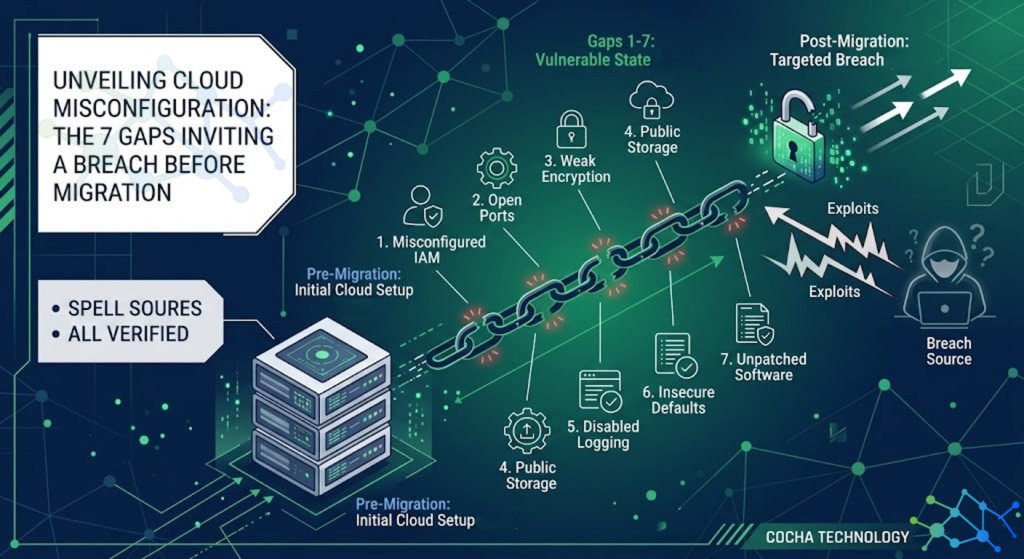
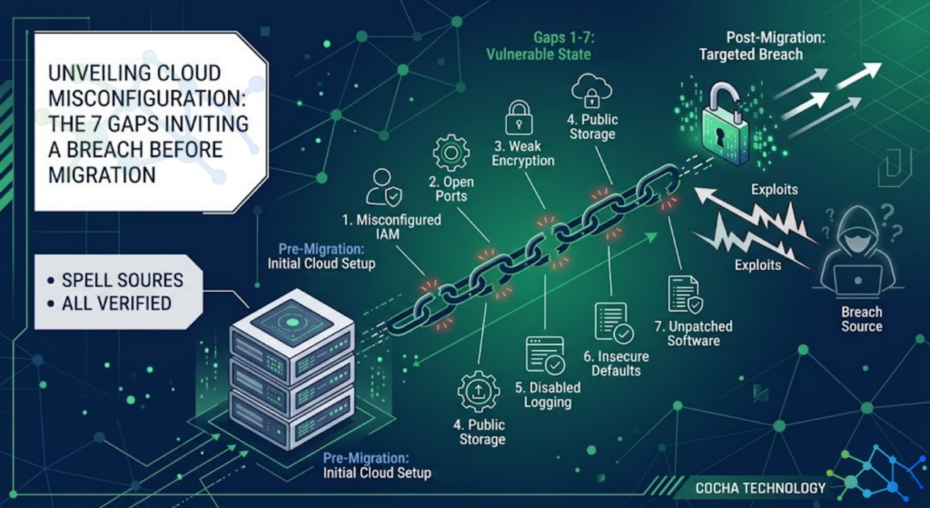
The 7 Gaps: Where Cloud Infrastructure Misconfiguration Hides
To protect your assets, you have to know where the armor is thinnest. Here are the seven most common gaps we encounter during pre-migration audits.
1. Public Storage Blobs with No Access Restriction
This is the “classic” cloud error. In the rush to test if an application can successfully write to an Azure Blob or an S3 bucket, a developer might temporarily set the access to “Public.”
How it happens: It’s done for convenience during the “Proof of Concept” phase and simply forgotten during the production push.
The Risk: Your data is indexed by search engines. If it’s on the public internet, it’s not a matter of if it will be found, but when.
2. Overprivileged Service Accounts
During migration, it’s common to see “Service Account A” granted Owner or Contributor rights just to ensure the migration tool has enough “juice” to move data.
How it happens: Troubleshooting permission errors is time-consuming. Giving an account “Global Admin” or “Full Contributor” status solves the problem instantly but leaves a massive lingering threat.
The Risk: If those credentials are leaked—perhaps through a vulnerable cloud agent—the attacker has the keys to your entire kingdom.
3. Open NSG Rules from Testing
Network Security Groups (NSGs) act as your cloud firewall. During migration, you might open port 3389 (RDP) or 22 (SSH) to the entire internet to allow a remote consultant to configure a VM.
How it happens: The migration ends, the consultant leaves, but the “AllowAll” rule stays in the NSG.
The Risk: Bruteforce bots scan the internet for open ports every second. An open RDP port is an open invitation for ransomware.
4. Entra ID (formerly Azure AD) Legacy Authentication
Microsoft has been pushing for Modern Auth for years, yet legacy protocols (like IMAP or POP3) often remain enabled because an old legacy app requires them.
How it happens: Organizations migrate their identity but don’t want to break old workflows, so they leave the “backdoor” of legacy auth open.
The Risk: Legacy authentication doesn’t support Multi-Factor Authentication (MFA). It is the #1 way accounts are compromised today.
5. Azure Key Vault Bypass
Hardcoding secrets in your application code or environment variables is a cardinal sin of cloud infrastructure misconfiguration.
How it happens: It’s faster to put a connection string directly in the code than it is to set up an Azure Key Vault and manage Managed Identities.
The Risk: Anyone with read access to the code or the environment configuration can see your database passwords and API keys.
6. Disabled Diagnostic Logging
You cannot defend what you cannot see.
How it happens: Logging costs money and consumes storage. To keep migration costs “lean,” teams might disable verbose logging or fail to send logs to a Log Analytics Workspace.
The Risk: If a breach occurs, you will have zero forensic evidence to determine what was stolen or how the attacker got in.
7. The "Flat" Network Trap
In a rush, many companies move their Dev, Stage, and Prod environments into the same Virtual Network (VNet) without internal segmentation.
How it happens: It’s easier to manage one VNet than three.
The Risk: If a developer’s laptop is compromised and they have access to the Dev environment, the attacker can move laterally into your Production database because there is no “firewall” between them.
What a Pre-Migration Scan Catches
The “Lean and Mean” philosophy we champion at Cocha Technology isn’t just about speed; it’s about precision. A professional configuration scan before the final cutover acts as a safety net.
Instead of waiting for a breach to tell you that your cloud misconfiguration security is lacking, a scan looks at the “metadata” of your infrastructure. It identifies that open port, that unencrypted disk, and that overprivileged account before they are exposed to the live web.
The principle is simple: Fix it before you migrate it. Correcting a misconfigured NSG takes thirty seconds in a staging environment. Dealing with a data leak after the site is live can take years of legal battles and brand repair.
Don't Migrate Your Mistakes
Migration should be a fresh start, not a way to carry old vulnerabilities into a new, more expensive environment. If you’re feeling the pressure of a deadline, remember that Steve and the team at Cocha Technology have been in the trenches. We know that a little bit of foresight goes a long way in preventing a catastrophic cloud infrastructure misconfiguration.
Before you flip the switch on your next big move, let’s make sure you aren’t leaving the lights on for the wrong people.
Take the Next Step: The Exposure Snapshot
Are you confident your current cloud setup is secure? Our Exposure Snapshot is a focused, high-impact audit designed to find the gaps before the hackers do. Don’t leave your migration to chance.
Recent Posts
Have Any Question?
Call or email Cocha. We can help with your cybersecurity needs!
- (281) 607-0616
- info@cochatechnology.com
About the Author:

Steve Combs
Co-Founder & Managing Director, Cocha Technology
Steven is a fractional CIO/CISO with 30+ years of enterprise IT and security leadership. He has built AI governance frameworks for organizations with 1,700+ users, led enterprise Microsoft Copilot deployments, and conducted security assessments across law firms, energy companies, financial institutions, and PE-backed manufacturers.