Exposure Snapshot: 3 Negative Risks in Your Medical Device OEM Agreement
May 27, 2026
In our thirty years of consulting, we’ve worked with several medical device manufacturers who operate under the highest levels of scrutiny. In this industry, “precision” isn’t a buzzword; it’s the difference between a successful surgery and a product recall. I remember when the biggest risk was the “gray market” for parts. Today, the risk is the “Shadow Market” for AI-driven design.
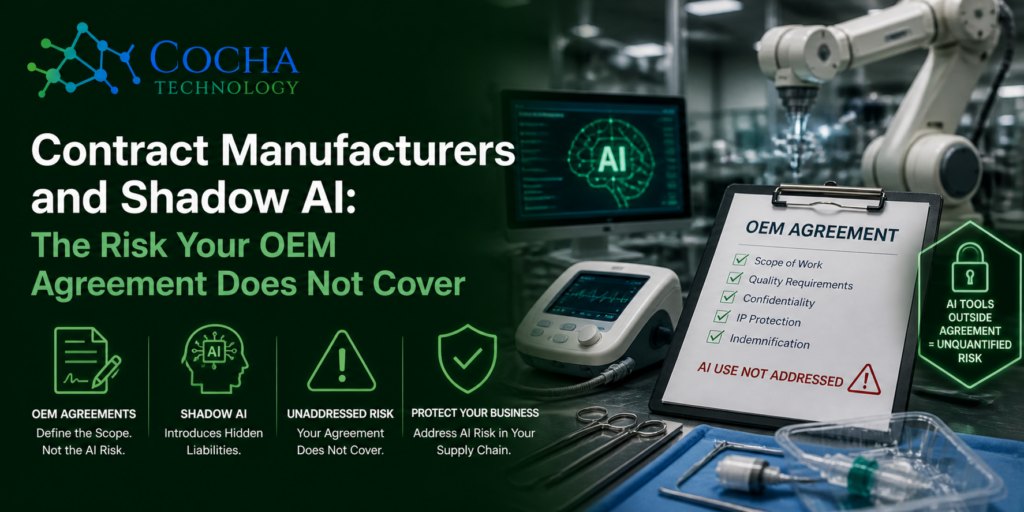
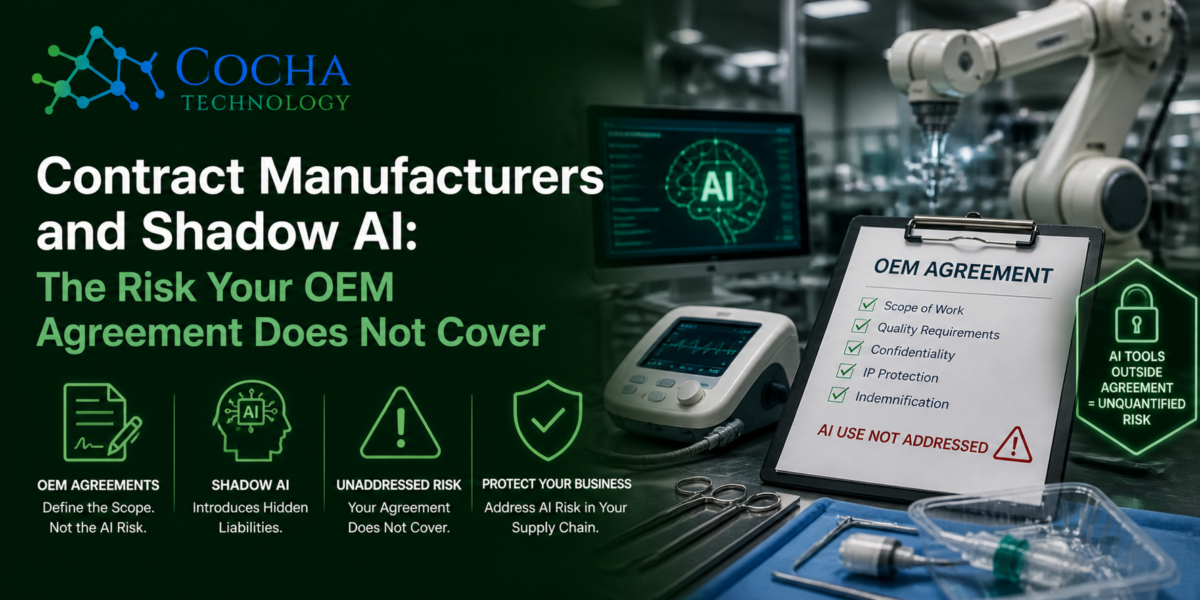
As we move through 2026, the medical device supply chain is becoming increasingly complex. You rely on contract manufacturers and OEMs to produce the components that make your devices lifesaving. But while your internal quality systems are ironclad, your partners are likely using “Shadow AI” to optimize their production lines. If you haven’t performed an Exposure Snapshot on your manufacturer network, you have a massive vulnerability that no standard OEM agreement is currently covering.
The Design Leak: When Your Blueprints Train the Global AI
In the world of medical device manufacturing, your Intellectual Property (IP) isn’t just a business asset—it is the very soul of your company. It represents years of R&D, clinical trials, and regulatory hurdles. When you hand off a precision design to an Original Equipment Manufacturer (OEM), you do so under the assumption that your data will remain within their secure, audited perimeter. However, the reality of 2026 is far more complex. Driven by the pressure to reduce lead times, many contract manufacturers are quietly integrating AI “coding assistants” or generative design optimizers into their fabrication workflows.
The negative risk here is profound and potentially irreversible. If a manufacturer’s engineer uploads your proprietary CAD blueprints or metallurgical specifications into a public AI tool to “troubleshoot a tolerance issue” or “optimize a toolpath,” that data is instantly ingested into a public cloud. It is no longer yours. It becomes part of a global AI training set, effectively “teaching” the model the unique nuances of your life-saving innovation. This means that, inadvertently, your proprietary secrets could be used to generate design suggestions for your direct competitors. At Cocha Technology, our Exposure Snapshot audits often reveal that sensitive data is leaking into public models through these third-party tools—utilities that were never vetted for security and lack the basic “Ring Fencing” required for MedTech IP.
The Validation Gap: AI-Generated Design Flaws
FDA and ISO 13485 standards are built on a foundation of rigorous validation. Every design change, no matter how minor it seems, must be documented, tested, and approved. But what happens to that validation chain when an OEM uses “Shadow AI” to suggest a minor “optimization” to a material grade or a part geometry? If that change is implemented because “the AI said it was more efficient” and it bypasses the manual scrutiny of a human engineer, you’ve created a lethal validation gap.
In the medical device field, AI hallucinations aren’t just a technical glitch; they can be fatal. If an unmanaged AI “hallucinates” a material property or a stress tolerance that leads to a fatigue failure in a spinal implant, a pacemaker lead, or a cardiac valve, the regulatory and legal liability falls squarely on your brand, not the contract manufacturer. Standard OEM agreements are currently “blind” to AI-driven errors. They don’t account for the algorithmic logic used to tweak a production run, leaving a massive legal and financial gap in your risk management strategy.
✦ The “Optimized” Valve: We once worked with a device company that discovered their OEM had used an unmanaged AI tool to “reduce material waste” during the manufacturing of a critical heart valve component. On paper, the AI suggested a slightly different cutting toolpath that looked brilliant—it saved 15% in raw material costs. However, that new path introduced microscopic stress fractures in the titanium housing that were invisible to standard post-production inspection. They only appeared when the component was subjected to the extreme, repetitive pressure found in the human body.
Because the manufacturer’s AI was a “Shadow” tool, there was no digital audit trail explaining why the change was made or what logic was used to justify it. We had to perform an emergency Exposure Snapshot across their entire global supply chain to identify what other “optimizations” had been made without human oversight. It was a wake-up call: in the age of AI, you have to audit the logic, not just the product.
Data Lifecycle Management and "Digital Persistence"
Medical device data has an incredibly long tail. Regulatory bodies require storage, traceability, and “clean” data records for decades. When an OEM uses “Shadow AI,” they may be creating what I call a “Digital Ghost” of your data. This is proprietary information that persists on public servers, cached in AI conversation histories or training weights, long after your contract with that manufacturer has ended or the product has been discontinued.
Without proper Data Lifecycle Management, you lose the ability to “recall” your data. Once it enters the manufacturer’s unmanaged AI-enhanced ecosystem, it effectively has infinite persistence. At Cocha Technology, we utilize technical siloing to ensure that your data remains within a “Closed Loop.” This ensures that your IP is not only secure during the active phase of production but that it truly “expires” and is deleted across the entire supply chain when it is no longer needed. We help you move from a state of “Digital Persistence” to a state of “Digital Governance.”
Protecting Your IP with DSPM and Exposure Snapshots
You cannot secure a supply chain you cannot see. This is why our methodology focuses heavily on Data Security Posture Management (DSPM). DSPM acts as a high-resolution tracker, allowing you to monitor the “pedigree” of your designs as they move through your manufacturer network. It identifies not just where the data is, but how it is being interacted with.
The first step in securing your innovation is identifying your current points of failure. Our Exposure Snapshot audit looks specifically at your third-party manufacturer interactions to reveal exactly where “Shadow AI” is bypassing your existing security controls. We don’t just find the holes; we help you implement Shadow AI Protection protocols that ensure your partners are held to the same rigorous security standards that you maintain internally.
Don't Let "Shadows" Fail Your Next Audit
In 2026, your OEM agreement is only as strong as your digital visibility. The FDA and international auditors are becoming increasingly savvy regarding AI’s role in the manufacturing process. Don’t wait for a catastrophic product failure or a massive IP leak to realize your partners are using unmanaged AI to handle your designs.
At Cocha Technology, we combine thirty years of IT veteran experience with the rigorous security standards required by the medical device industry. We understand that in MedTech, technology must serve safety and compliance first. Let’s make sure your “Innovation” stays yours and isn’t used to train your competition’s next move.
Is your IP leaking through your supply chain? Get your Exposure Snapshot today and secure your medical device design.
Recent Posts
Have Any Question?
Call or email Cocha. We can help with your cybersecurity needs!
- (281) 607-0616
- info@cochatechnology.com
About the Author:

Steve Combs
Co-Founder & Managing Director,
Cocha Technology
Steven is a fractional CIO/CISO with 30+ years of enterprise IT and security leadership. He has built AI governance frameworks for organizations with 1,700+ users, led enterprise Microsoft Copilot deployments, and conducted security assessments across law firms, energy companies, financial institutions, and PE-backed manufacturers.