Copilot data security starts with permissions, not with Copilot. To ring-fence Microsoft 365 Copilot data, fix what each person can already open, because Copilot answers from that access. In practice that means tightening sharing, applying sensitivity labels and DLP, clearing stale content, and finding shadow AI. A DSPM review tells you where overshared data sits before you start. Most law firms turned Copilot on in 2024 or 2025, so this is hardening a live rollout.
When you’re ready to check your own tenant, request the free AI Readiness Snapshot.
To align procurement with your security plan, compare E3, E5 and E7 before you buy Copilot.
Copilot security risks: the illusion of automatic safety
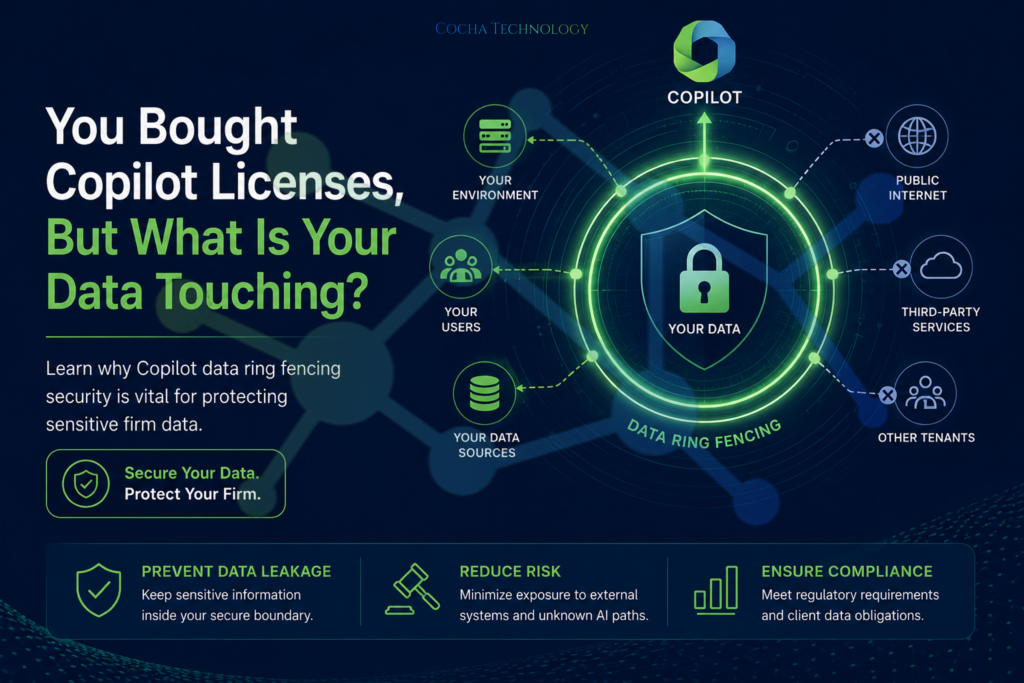
Many leaders assume that because Copilot lives within the Microsoft 365 ecosystem, it is inherently “safe.” Microsoft provides strong enterprise protections, but Copilot is only as secure as the permissions you’ve already set, or neglected. If an associate has access to a folder they shouldn’t, Copilot has access to it too.
Picture a firm where a junior staffer asks Copilot to summarize “all partner compensation files” and gets an answer. Nothing was hacked. The files sat in a SharePoint folder shared with “Everyone except external users,” and Copilot used the access that setting already gave. This is where Copilot data security moves from a technical checkbox to a business necessity.
1. Set the Copilot data security perimeter
The first step in any successful deployment is defining the boundary. In a PE-backed environment, you are often dealing with cross-portfolio data that must remain strictly isolated. Without a “ring fence,” the AI might inadvertently surface insights from “Company A” while an analyst is working on a report for “Company B.”
A professional Copilot Readiness review identifies these overlap risks before the first prompt is ever written. We look for “ghost permissions,” access rights granted years ago that are still active today, and shut them down.
2. Copilot oversharing in law and PE
In the legal sector, attorney-client privilege is the bedrock of the profession. Oversharing slows Copilot rollouts too. In September 2024, Computerworld reported on a Gartner survey of 132 IT leaders. Concerns about oversharing led 40% of them to delay rollout by three months or more, and 57% limited the rollout to low-risk or trusted users.
If a paralegal asks Copilot to “summarize the last three months of meeting notes for Client X,” and those notes happen to contain privileged data from Client Y because of a shared folder structure, you have a major compliance breach on your hands. Effective Copilot data security means auditing how your data is siloed so client matters stay logically separated within your tenant.
If you want a read on open permissions in your own tenant, request the free AI Readiness Snapshot.
3. Implementing Data Loss Prevention (DLP)
You cannot manage what you cannot see. Our approach to DLP (Data Loss Prevention) is built on the principle that AI should be an assistant, not an informant.
We implement sensitivity labels (e.g., “Highly Confidential,” “M&A Sensitive”) that Copilot respects. If a document is labeled “Privileged,” the AI is restricted from extracting that data into a general summary that might be seen by unauthorized users. This level of granularity is essential for PE firms managing sensitive exit strategies or legal teams handling high-profile litigation.
Microsoft explains the mechanics in Microsoft Purview data security and compliance protections for Microsoft 365 Copilot. When a label applies encryption, the person asking needs both VIEW and EXTRACT usage rights before Copilot returns that content.
The Cocha Perspective:
A Lesson in “Trust but Verify”
I’ve spent over 30 years in IT, and if there is one thing I’ve learned, it’s that “default settings” are the enemy of security. Picture a manufacturer that believes its data is siloed because each team has its own folders. In the cloud, a folder is only as private as its permissions. If the R&D library were open to the sales team, Copilot would let a salesperson summarize unpatented designs without anyone meaning to share them.
This is why we advocate for a Fortress Mindset.
4. Cleaning the "Digital Junk Drawer"
Before you turn on Copilot, you must perform a 4-Step Content Audit. If your firm has ten years of “draft” documents, outdated “company updates,” and legacy files sitting in SharePoint, Copilot will use them.
Imagine Copilot giving an analyst a valuation based on a 2019 “Draft” spreadsheet instead of the 2026 “Final” version. Copilot data security requires pruning the “dead weight” from your environment so Copilot only draws on current, accurate files.
5. Identifying "Shadow AI" Risks
Even with Copilot, your team might still be using unmanaged, public AI tools like free versions of ChatGPT or rogue PDF summarizers. Our Shadow AI Protection work often finds that employees use these tools because they find them “faster.”
By providing a secure, managed Copilot environment, you offer them the speed they want with the protection the firm requires. We substitute the dangerous “public” window for a secure “ring-fenced” agent.
Shadow AI and agent reach are covered in the free AI Readiness Snapshot.
6. The Future of AI Sovereignty in Law
As regulators increase pressure on data sovereignty, having a documented Copilot data security plan becomes a competitive advantage. It proves to your PE stakeholders and legal clients that you are a “Modern Operator” who respects the gravity of their data.
We help you move away from “keyword whack-a-mole” and toward a state of AI Sovereignty, where you own the intelligence and the infrastructure it sits on.
7. Ongoing Monitoring and "FinOps"
The deployment doesn’t end on day one. To maintain a healthy environment, you must engage in constant cost and security optimization. The cloud is a variable expense, and unmanaged AI usage can lead to “License Sprawl.” We use Cloud FinOps principles to ensure you are getting the maximum ROI on those expensive Copilot seats without compromising on safety.
Copilot data security FAQ
Does Copilot respect SharePoint permissions?
Yes. Microsoft 365 Copilot runs in the security context of the person asking, so it only uses content that person can already open. Microsoft’s Data, Privacy, and Security for Microsoft Copilot page puts it this way: Copilot only surfaces organizational data the user has at least view permission for. That’s also the risk. If a matter folder is shared with everyone in the firm, Copilot can summarize it for anyone. Ring-fencing starts with fixing those permissions.
Can sensitivity labels keep documents out of Copilot answers?
Yes, with a Microsoft Purview DLP policy. A rule on the Microsoft 365 Copilot and Copilot Chat location can stop Copilot from processing files and emails that carry chosen sensitivity labels. The item may still appear in citations, but Copilot won’t use its content. Policy changes can take up to four hours to apply.
Prove the perimeter with a free Snapshot
Buying the licenses was the easy part. Ensuring those licenses don’t become a backdoor to matter data is the real work. For firms that already turned Copilot on in 2024 or 2025, ring-fencing is a re-deploy and harden job: tighten permissions, DLP, and identity, then verify what agents can still reach.
Next step: the free AI Readiness Snapshot, which covers permissions, data protection, monitoring, shadow AI, and Secure Score. Related: Copilot Readiness, DLP, and the Claude agent ring-fence case.
Don’t wait for a leak to learn what Copilot can already see. Get a free AI Readiness Snapshot