

VMware Azure migration security assessment: 5 Critical Findings That Protect Your Bottom Line
May 18, 2026
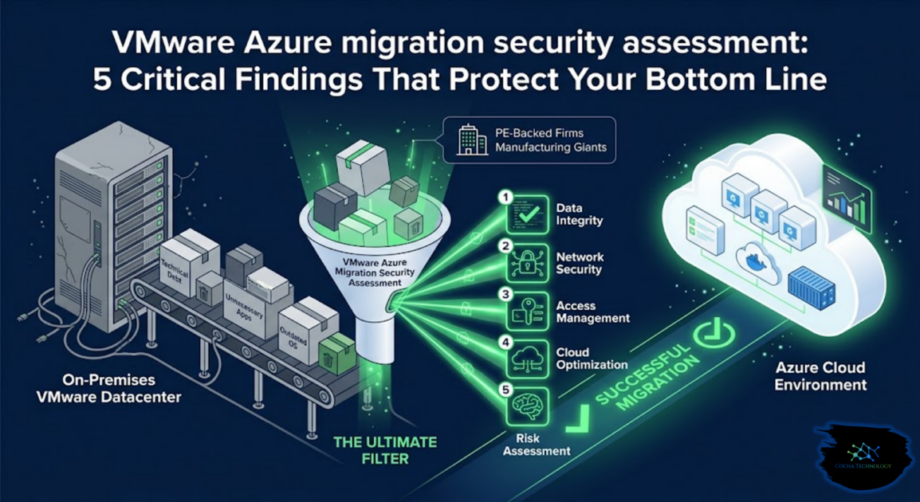
For many private equity-backed (PE) firms and manufacturing giants, the recent tectonic shifts in the VMware and Broadcom landscape have moved a “someday” project to the top of the “must-do-now” list. Migration to the cloud is no longer just about agility; it is about cost predictability, vendor independence, and long-term sustainability. However, jumping from a familiar on-premises hypervisor to the public cloud isn’t a simple “copy-paste” job. The most successful, risk-averse transitions begin with a comprehensive VMware Azure migration security assessment.
At Cocha Technology, we’ve found that the transition to the cloud is the perfect time to shed the “technical debt” of the past. A cloud migration is essentially a “digital move”—and you don’t want to pack the trash from your old house into your new one. A structured VMware Azure migration security assessment acts as the ultimate filter, ensuring only what is necessary and secure makes the trip.
1. Identifying "Ghost" Assets and Technical Debt
The first thing a VMware Azure migration security assessment usually uncovers is a startling number of “ghost” servers. These are legacy Virtual Machines (VMs) that were spun up for a project in 2019, forgotten by the original admin, but are still running, consuming power, and—most importantly—offering a massive, unpatched attack surface for hackers.
In a manufacturing environment, these ghost assets are often connected to old shop-floor controllers. Research from Vanson Bourne for Armis highlights that unmanaged or “forgotten” assets are a significant security blind spot for global enterprises. By identifying these during the Azure Migration planning phase, we can either decommission them or wrap them in modern security protocols before they touch the cloud.
3. Configuration Drifts and Compliance Gaps
Manufacturers and PE firms often have strict compliance requirements like CMMC or SOC2. Over years of on-premise management, “configuration drift” occurs—settings are changed for a “quick fix” but never reverted. Our VMware Azure migration security assessment flags these gaps, allowing us to build “Policy as Code” in Azure.
This ensures that your Cloud Security posture is not only stronger but automatically stays compliant. Experts at Gartner have famously predicted that through 2025, nearly all cloud security failures will be the customer’s fault, often due to these very misconfigurations.
4. Over-Provisioned Permissions (The "Admin" Problem)
In the rush of daily operations, it’s common for too many people to have “Domain Admin” rights on-premise. During a VMware Azure migration security assessment, we often find that internal permissions are far too broad, creating a “keys to the kingdom” scenario where a single compromised account can lead to a total environment takeover. This is particularly dangerous for PE-backed firms where sensitive deal data must be strictly isolated from general administrative oversight.
Moving to Azure allows us to implement Role-Based Access Control (RBAC) and Just-In-Time (JIT) access. RBAC ensures that an analyst in a PE firm can see the specific data they need for due diligence without having the power to accidentally delete an entire database or modify global network settings. JIT access takes this a step further by providing elevated privileges only when they are needed and only for a specific duration, effectively closing the window of opportunity for attackers. This transition from “always-on” permissions to “least-privileged” access is a foundational element of our Zero Trust Assessment methodology.
5. Shadow IT and Hidden Cloud Spend
Finally, an assessment reveals the “hidden” cloud usage already happening in your company. In manufacturing, teams often spin up their own localized cloud solutions—unmanaged SaaS tools or standalone storage buckets—to solve immediate problems on the shop floor without waiting for IT approval. While these “quick fixes” keep production moving, they create significant security blind spots and fragmented data sets.
By bringing these rogue operations into a unified Azure framework, you gain:
Visibility: We map out your entire digital estate, ensuring you know exactly where every byte of your data lives and who is accessing it.
Risk Mitigation: We bring unmanaged tools under the corporate umbrella, ensuring all applications meet the same rigorous security standards as your core production systems.
FinOps Optimization: We identify and eliminate redundant subscriptions and overlapping services, significantly optimizing your cloud spend.
Governance and Control: We implement centralized policies that prevent “Shadow IT” from recurring, ensuring that future innovations on the manufacturing floor are built on a secure, approved foundation.
This consolidated approach not only lowers your risk profile but also optimizes your Cloud FinOps to eliminate redundant subscriptions.
The Cocha Perspective:
A Lesson in Visibility
I remember working with a manufacturing client who was convinced they only had 50 servers to migrate. Our initial VMware Azure migration security assessment actually found 72. Those extra 22 servers were legacy “test” environments still communicating with their live production database. Had we migrated without the assessment, they would have carried a massive security hole—and a much higher bill—directly into their new tenant.
Secure Your Future: Beyond the Migration Finish Line
The Broadcom shift has made the question of “if” you will migrate a matter of “when,” but for manufacturing and PE-backed firms, the true focus must be on “how.” Moving your infrastructure without a VMware Azure migration security assessment is like driving a high-performance vehicle with a blindfold; you might gain speed, but the risk of a catastrophic collision with hidden technical debt is simply too high. By choosing to lead with a Fortress Mindset, you ensure that your migration is not just a change in digital zip codes, but a strategic upgrade that sheds legacy vulnerabilities and optimizes your bottom line. At Cocha Technology, we leverage our 30+ years of IT experience to ensure that your path to Azure is clear, compliant, and cost-effective.
Don’t let your “digital move” become a liability. Secure your Zero Trust Assessment today and build a cloud architecture that lasts.
Recent Posts
Have Any Question?
Call or email Cocha. We can help with your cybersecurity needs!
- (281) 607-0616
- info@cochatechnology.com
About the Author:

Steve Combs
Co-Founder & Managing Director,
Cocha Technology
Steven is a fractional CIO/CISO with 30+ years of enterprise IT and security leadership. He has built AI governance frameworks for organizations with 1,700+ users, led enterprise Microsoft Copilot deployments, and conducted security assessments across law firms, energy companies, financial institutions, and PE-backed manufacturers.