8 Governance Controls to Turn on Before a Grok Bot Touches Your Portfolio Company’s Deal Data


The AI Paradox: Innovate Now with Microsoft 365 Copilot Without the Wait
February 12, 2026
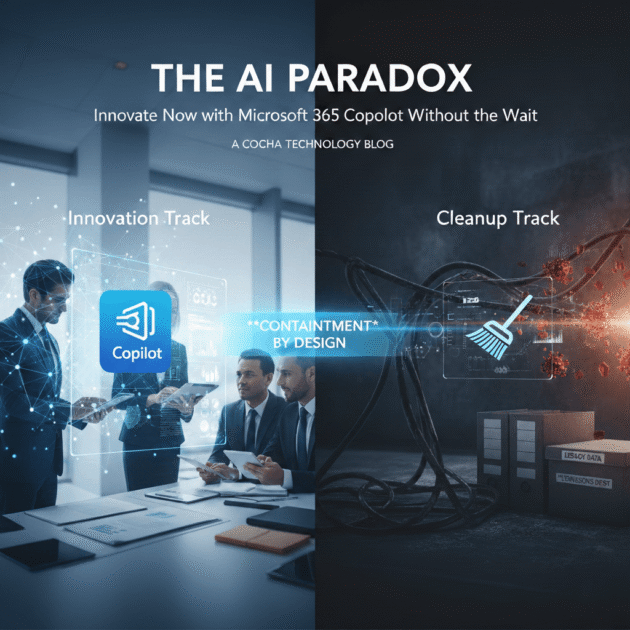
The CIO’s High-Stakes Balancing Act
In the current legal landscape, Law Firm CIOs and CISOs are caught in a tightening vice. On one side, Board-level mandates demand immediate Generative AI (Microsoft Copilot quite commonly) integration to maintain a competitive edge. On the other, “CISO paralysis” stems from a legitimate fear of exposing sensitive client data to unproven systems. This tension has birthed a significant transparency gap. While corporate legal departments are rapidly accelerating Microsoft Copilot adoption for drafting and research, law firms are lagging due to visibility and cost-value concerns.
This gap is fueling a burgeoning Data War. According to the Bressler Risk source, clients increasingly view their data as a strategic corporate asset and want to use it for their own proprietary AI tools. Simultaneously, law firms seek to use that same data to fine-tune their own models. This conflict, combined with the AI Paradox—the debilitating belief that a firm’s data is too “messy” or “unsecured” to be used for innovation—threatens to stall progress indefinitely. As Strategists, we must recognize that waiting for data perfection is not a security posture; it is a competitive surrender.
Shattering the Myth of "Permissions Debt"
The strategic trap paralyzing most IT departments is the false binary of “Clean Data or No AI.” A common myth suggests that a firm must resolve 20 years of permissions debt and “messy data” before launching a Microsoft 365 pilot. We must reject this.
Waiting for total data remediation is unnecessary because modern architecture allows for “Containment by Design.” While Organizational Debt (redundant, obsolete, and trivial data) and Permissions Debt (over-privileged access) are real risks, they must be handled as a background operational track, not a blocker to front-end innovation. Strategy best practices dictate that we pilot high-value, repetitive tasks now while the slower work of data hardening continues in parallel.
Providing Smart security
Lorem ipsum dolor sit amet, consectetur adipiscing elit, sed do eiusmod tempor incididunt ut labore et dolore magna aliqua. Ut enim ad minim veniam, quis nostrud exercitation ullamco laboris nisi ut aliquip ex ea commodo consequat. Duis aute irure dolor in reprehenderit in voluptate velit esse cillum dolore eu fugiat nulla pariatur. Excepteur sint occaecat cupidatat non proident
Containment by Design: The Technical Safety Net
The technical reality of Microsoft 365 Copilot dispels the common “client fear” that inputs will leak into public models. The security architecture of Microsoft 365 Copilot, for instance, is grounded in a Zero Trust framework and fundamentally respects existing Entra ID (Azure AD) permissions.
To provide forensic-level assurance to clients, CIOs should reference the Service Trust Portal and specific SOC 2 Type II / ISO 27001 attestations. These documents confirm that data is isolated and that enterprise tools do not use client inputs to train external foundation models.
Core Safeguards of Containment by Design:
- Segmented Instances: Data processing occurs within firm-controlled or vendor-segregated cloud instances.
- Region-Locked Environments: Dataresidesand is processed within specified geographical jurisdictions.
- Single-Tenant Isolation: Technical blocks prevent cross-matter data blending or leakage between clients.
- DPA Model-Training Exclusions: Explicit contractual guarantees and Data Processing Agreements (DPAs) that ensure client data is never used to improve base models.
Shifting the Risk: The "User-in-the-Loop" Protocol
We must position Microsoft Copilot as an “engine,” not an “autopilot.” This shifts the liability framework from “System Failure” to “Supervision Protocols,” where the human lawyer remains the final arbiter of truth. To manage the inherent risk of hallucinations, we deploy a layered detection framework.
- Self-Declared Uncertainty: Modern models provide metacognitive signals, verbalizing confidence estimates. Low-confidence outputs are flagged for manual verification.
- RACE (Reasoning and Answer Consistency Evaluation): This framework is critical for high-stakes legal work. It jointly evaluates answer correctness and reasoning consistency to penalize models that “get the right answer for the wrong reasons.”For example, an AI might correctly flag a loan for rejection but cite an incorrect regulatory clause in its reasoning. RACE ensures such flawed reasoning is surfaced before it undermines professional trust.
- Multi-pass Self-evaluation: The system generates multiple reasoning paths, acting as its own “critic” toidentifyand filter inconsistent outliers.
The Parallel Track Strategy: A Dual-Speed Execution
The solution to AI Paradox is a dual-speed methodology that separates innovation from hygiene.
Track 1: The Green-Light Pilot Select a tech-savvy group to test Microsoft 365 Copilot on repetitive tasks. Focus on boilerplate clause review, where 70% of typical agreements rely on standard templates. Data from Evangelize Consulting indicates that AI can reduce manual review time from 90 minutes per contract to mere seconds, handled by a tireless “junior reviewer” while lawyers focus on the 30% of bespoke, non-standard clauses.
Track 2: The Continuous Cleanup (DSPM) Simultaneously launch a Data Security Posture Management (DSPM) initiative to tackle ROT (Redundant, Obsolete, Trivial) data and harden permissions via Entra ID.
Feature | Pilot Track (Innovation) | Cleanup Track (Hygiene) |
Primary Focus | Productivity & Value Mapping | Risk Mitigation & Permission Debt |
Target Data | Current matter data & playbooks | ROT data & legacy archives |
Key Metric | 30% reduction in review time | Volume of data purged / ROT reduction |
Stakeholders | Innovation teams & Partners | IT, Security, & Risk Management |
Governance and the Business Case for Progress
To justify the pilot to the Board, the CIO must utilize the Five Case Model:
1. Strategic Case: Addressing the “Transparency Gap” to meet client expectations for AI-driven efficiency.
2. Economic Case: Achieving a 30% reduction in human review time and reallocating high-cost lawyer hours to bespoke advisory work.
3. Commercial Case: Managing vendor risk through SOC 2 Type II and ISO 27001 attestations.
4. Financial Case: Offsetting implementation costs through measurable efficiency gains within the first year.
5. Management Case: Implementing “User-in-the-Loop” guardrails and benefit realization plans.
Furthermore, we must navigate the legal nuances of the Judge Stein / OpenAI ruling. Judge Stein clarified that while attorney-client privilege protects legal advice, the “Technical Truth”—factual statements about data lifecycle management, provenance, logs, and “non-use” of data—is discoverable. CIOs must ensure forensic-level governance from day one because the facts of data management are not shielded by privilege.
Finally, we must advise clients that anonymization is a moving target. Stripping direct identifiers does not guarantee data ownership or safety, as re-identification remains possible in small datasets or public disputes. Robust DSPM and clear Outside Counsel Guidelines (OCGs) defining data ownership are the only true safeguards in the “Data War.”
Conclusion: Ring-fencing the Future
Perfection is the enemy of progress. Law firms that wait for a pristine data environment will find themselves permanently behind a transparency gap that is already alienating corporate clients.
The CIO must “ring-fence” the data—applying rigorous containment by design and the RACE framework to a controlled environment—and start the pilot now. By moving from reactive “invoice processing” to strategic spend and innovation management, the CIO transforms the firm’s data from a liability into a strategic infrastructure. The directive is clear: Innovate on Track 1, clean up on Track 2, and lead the firm into the Microsoft 365 Copilot era.
Ready to solve the AI Paradox? Infrastructure readiness is the difference between an AI tool that works and an AI tool that waits. Call us today or fill out the above form to see how Cocha Technology can help you build a resilient foundation for your Copilot deployment