
The GenAI Honeymoon Is Over. Here’s How to Handle the Bill.
A FinOps Domains-first playbook to stop AI cost sprawl and scale with confidence.
December 30, 2025
Remember when Generative AI was just a ‘wow’ moment? It was exciting. Then, the pilots moved into production, usage spiked, and the invoice landed. Data from the Stanford 2025 AI Index Report confirms this shift, showing that while enterprise adoption has surged, the costs of high-end model training and inference have reached unprecedented levels.
Suddenly, the focus shifted from pure innovation to achieving a sustainable Generative AI ROI. The question is no longer just “How do we build this?” but “How do we fund this while ensuring the business sees a clear return on investment?”
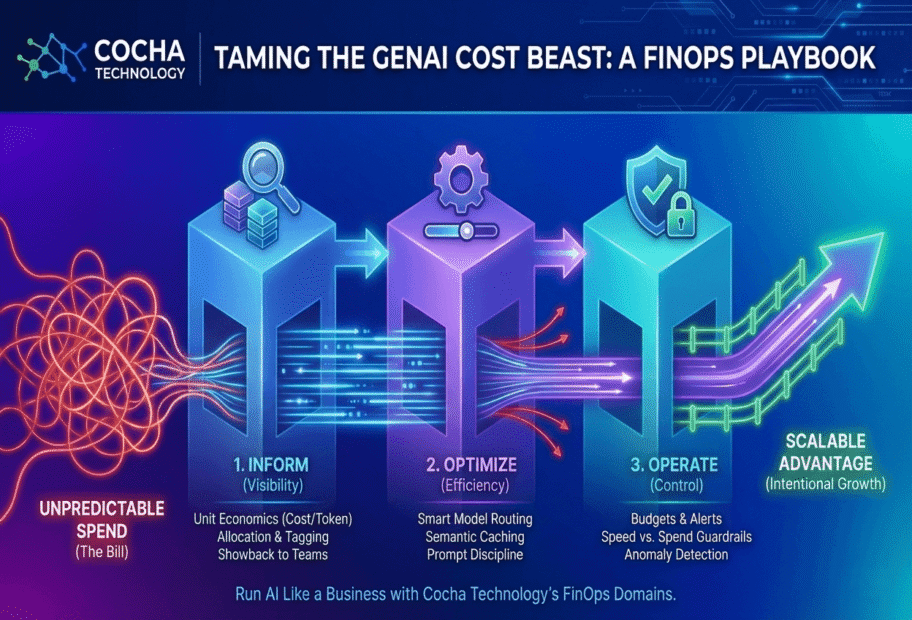
The answer isn’t to stop building. The answer is to start running AI like a business using the FinOps Domains: Inform, Optimize, and Operate.
When you anchor your decisions in these three domains, costs stop being a terrifying variable and start being a deliberate investment. At Cocha Technology, we’ve applied these domains to real-world GenAI workloads. Here is a practical, human-centered rewrite of your cost strategy, mapped to the components you actually need.
1. Inform
Goal: Build shared visibility for Generative AI ROI. Every dollar needs an owner and a purpose.
You can’t fix what you can’t see. The “Inform” phase is about turning the lights on so you know exactly who is spending what, and why. By tracking the right data, you can finally measure your true Generative AI ROI.
The Core Components
- Ingest the Data: Pull cost data across all your clouds and AI vendors into one view.
- Assign Ownership: Attribute costs to specific products, features, and teams. No “unallocated” bucket.
- Establish Metrics: Track unit economics like Cost per token and Cost per request. This is the foundation of calculating Generative AI ROI.
- Show back: ensure teams see their spend. Accountability starts with awareness.
The GenAI Reality Check: The silent budget killer usually isn’t model training—it’s inference. You have to treat inference with unit economics to protect your Generative AI ROI, moving away from a fixed capital mindset.
Decisions You Can Finally Make
- Which features actually have healthy margins?
- Which customer tiers require a price change or a usage limit?
- Where is “token bloat” quietly eroding your value?
2. Optimize
Goal: Cut the waste to boost Generative AI ROI
Optimization isn’t just about spending less; it’s about spending smarter. You want to reduce waste without slowing your engineering teams down.
The Tactics That Move the Needle
- Smart Model Routing: Default to the smallest model capable of the job. Only escalate to expensive models when quality checks fail. This is the fastest way to improve your Generative AI ROI.
- Semantic Caching: If ten users ask the same question, why pay for the answer ten times? Serve repeat intents from a cache. Your costs go down, your latency drops, and your Generative AI ROI climbs.
- Prompt Discipline: Trimming matters. Shorten system prompts, remove filler language, and impose strict response limits.
Outcomes to Measure
- Token reduction per feature.
- Cache hit rates (aim high!).
- The percentage of traffic handled by small vs. large models.
For seat-based AI budgeting, review Copilot and Microsoft 365 license costs.
3. Operate
Goal: Embed cost control into your daily culture.
This is where the rubber meets the road. “Operate” ensures that maximizing Generative AI ROI isn’t a one-time meeting, but a part of your daily shipping cycle.
The “Speed vs. Spend” Triangle Scale, Speed, Spend. You usually get to pick two. To maintain a healthy Generative AI ROI at scale, you must protect your margins with premium tiers or feature-specific budgets.
The New Operating Rules
- Tag Everything: Every AI resource must belong to a team.
- Set Hard Stops: Features need monthly budgets. Soft alerts warn you; hard stops protect you.
- Kill Switches: If the budget is stressed, automatically disable escalation to large models.
- Rituals: Cost reviews are now part of sprint planning. Track unit economics like Cost per token and Cost per request. This is the foundation of calculating Generative AI ROI.
Putting the Domains to Work
Here is how these abstract concepts translate into four distinct strategies:
Strategy 1: Managing the “Inference Bill”
- Inform: Track cost-per-token by feature to stabilize your Generative AI ROI.
- Optimize: Cap tokens and shrink prompts to stabilize the run-rate.
- Operate: Set alerts on high-volume features so spikes trigger immediate action.
Strategy 2: Right-Sizing the Model
- Inform: track spend by model provider.
- Optimize: Route to small models first to ensure your Generative AI ROI isn’t eaten by overkill processing.
- Operate: Enforce policies that restrict premium model usage to premium tasks.
Strategy 3: The “Efficiency is Free” Mindset
- Inform: Show teams “before-and-after” metrics to prove the value.
- Optimize: Add semantic caching to your top repetitive tasks.
- Operate: Review cache hit rates weekly.
Strategy 4: Governance at Speed
- Inform: Forecast based on demand drivers, not historical averages.
- Operate: Assign owners and add Cost SLAs to every feature.
- Optimize: Refactor the code where the “cost per outcome” is weakest.
What "Good" Looks Like: A 30-Day Rollout
If you are ready to start, here is your four-week roadmap.:
- Week 1 (Inform): Connect your bills. Define your tags (product, team, customer). Stand up a dashboard showing cost-per-token. Show the engineers the bill.
- Week 2 (Optimize): Implement small-model defaults. Cap max tokens. Turn on semantic caching for your top 10 queries. Trim your top 100 costly prompts.
- Week 3 (Operate): Turn on anomaly detection. Set budgets with alerts at 80% and hard stops at 100%. Install kill switches for budget stress.
- Week 4 (Scale): Review unit economics. Prioritize your backlog based on the weakest margins. Bake cost sections into your design docs.
Summary
GenAI costs look unpredictable until you frame them in the FinOps Domains. Inform gives you ownership. Optimize turns engineering choices into savings. Operate makes spend intentional. When you run all three, your Generative AI ROI becomes a scalable advantage, not a cloud hangover.
 Ready to regain control of your cloud spend?
At Cocha Technology, we implement FinOps Domains for AI at production scale. Start with a clean baseline and a unit economics dashboard, then lock in operating guardrails that keep costs exactly where you want them.
Click here to schedule your FREE Cost Health
Recent Posts
Have Any Question?
Call or email Cocha. We can help with your cybersecurity needs!
- (281) 607-0616
- info@cochatechnology.com