Microsoft 365 E3 vs E5 vs E7: Which License Does Your Firm Need for Copilot?
February 6, 2026
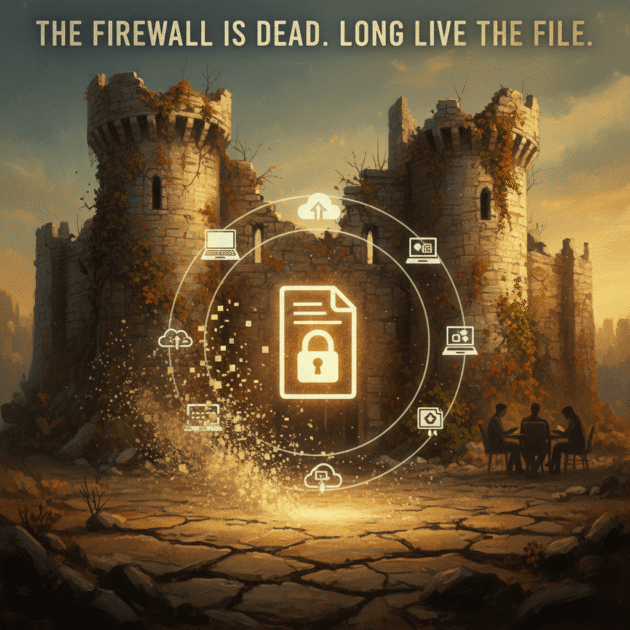
For decades, the standard for corporate security was the “castle and moat” strategy. We spent millions on the most sophisticated firewalls money could buy, effectively digging a deep, wide trench around the office. Inside that perimeter, everything was trusted; outside, everything was a threat. It was a clean, logical way to view the world.
But that world doesn’t exist anymore. In a landscape defined by remote work, SaaS applications, and global collaboration, the “network” has evaporated. When your employees are accessing sensitive financial data from a coffee shop in Greece, a home office in Houston, or a hotel in Italy, the firewall sitting in your empty headquarters is essentially a very expensive paperweight.
If your security strategy relies on your employees being in the office, you don’t have a security strategy. You have a legacy dependency that is actively creating blind spots. It’s time to accept the “Perimeter Fallacy” and shift the focus from protecting the network to protecting the data itself.
The concept of a perimeter was built on the assumption of physical presence. We assumed that if we could control the wires and the Wi-Fi in a specific building, we could control the flow of information. However, digital transformation has moved the goalposts.
Today, data is fluid. It lives in SharePoint, travels through Teams, sits in personal OneDrive folders, and is often downloaded onto unmanaged devices. The moment a document leaves your physical or virtual private network, your traditional firewall loses all visibility. You can’t put a moat around a cloud.
This shift requires a fundamental change in mindset: The file is the new perimeter.
Instead of trying to secure the environment where the data lives, we must secure the data regardless of where it travels. This is the essence of modern Data Loss Prevention (DLP). By embedding security directly into the file—through encryption, sensitivity labels, and access rights—the protection stays with the data even if it’s leaked, emailed to the wrong person, or uploaded to a public drive.
Many organizations tried to solve the remote work problem by simply extending the moat via VPNs. But VPNs are often clunky, slow down productivity, and, more importantly, they provide a false sense of security. Once a user is “on the VPN,” they often have broad lateral access to the network. If a single set of credentials is compromised, the attacker isn’t just in the user’s laptop; they are inside the castle.
A data-centric approach, like implementing Microsoft Purview, moves away from this “all-or-nothing” access. It focuses on Zero Trust principles: never trust, always verify, and give the least amount of privilege necessary to get the job done.
Implementing a data loss prevention strategy isn’t just about turning on a piece of software. It’s about understanding the “DNA” of your organization’s information. You have to know what you have before you can protect it.
A successful DLP strategy generally follows three phases:
When looking for remote work security solutions, the goal should be friction-less protection. If security is too hard, employees will find a workaround. This is why integrated tools are so much more effective than bolted-on third-party software.
Microsoft DLP, for example, is baked directly into the Office apps people use every day. When an employee is writing an email in Outlook and includes sensitive data, a “Policy Tip” can appear in real-time, reminding them of the company’s security standards. This turns security from a “no” department into a partner in productivity.
According to a recent report by Gartner, the shift toward integrated DLP is accelerating as companies realize that standalone tools create “data silos” that are impossible to manage at scale. By using tools that already understand your email, your cloud storage, and your endpoint devices, you create a unified front against data exfiltration.
While the technology is vital, we can’t ignore the human factor. Most data leaks aren’t the result of malicious hackers in dark rooms; they are the result of well-meaning employees making mistakes. Someone sends the wrong attachment to a vendor, or someone uses an unapproved AI tool to summarize a confidential meeting transcript.
By focusing on the file, you protect the employee from their own mistakes. If a file is encrypted and “wrapped” in a security policy, it doesn’t matter if it gets sent to the wrong person—they won’t be able to open it. This takes the pressure off the individual and puts the safeguard into the digital fabric of the company.
The Cybersecurity & Infrastructure Security Agency (CISA) emphasizes that data protection is a core pillar of the Zero Trust Maturity Model. It’s not a “set it and forget it” project, but an evolving part of how a modern business operates.
The perimeter isn’t coming back. The future of work is hybrid, distributed, and increasingly mobile. Holding onto the idea that a firewall is your primary line of defense is a dangerous gamble.
To stay competitive and secure, you must bring the security to the data. When you implement Microsoft DLP and embrace a data-centric model, you aren’t just checking a compliance box—you are building a resilient organization that can work from anywhere without fear.
The firewall is dead. It’s time to start protecting the file.
Call or email Cocha. We can help with your cybersecurity needs!