

VMware to Azure Migration Broadcom: 5 Positive Reasons to Exit the Price Trap
May 11, 2026
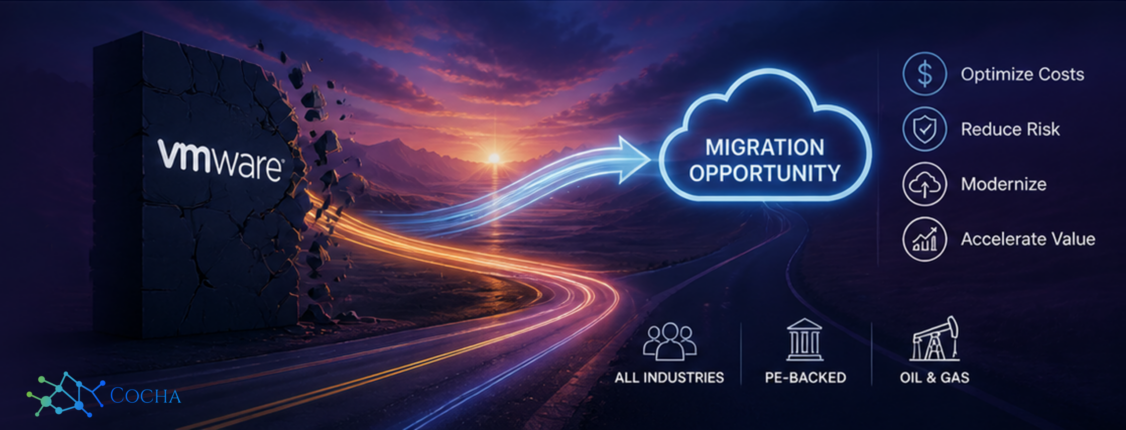
In thirty years of managing IT infrastructure, we have seen many vendor acquisitions, but few have sent shockwaves through the industry like the Broadcom acquisition of VMware. For years, VMware was the bedrock of the data center—the reliable, “set it and forget it” virtualization layer for everything from Law Firms to Oil & Gas operations. But the recent shift to mandatory subscription bundles and the “price reset” has left many CIOs feeling like they are being held hostage by their own infrastructure.
However, after three decades in this seat, we’ve learned that every “crisis” in IT is actually a catalyst for much-needed change. The Broadcom situation isn’t just an added line item in your budget; it is a clear signal that the era of legacy, on-premises virtualization, is closing. A VMware to Azure migration Broadcom strategy is no longer just a “project for next year”—it is your best opportunity to modernize your stack, reduce your technical debt, and finally achieve true operational resilience.
1. Breaking the Perpetual Licensing Trap
The “Broadcom effect” has effectively ended the era of perpetual licensing. For many PE-backed firms and O&G companies, this sudden spike in OpEx is a bitter pill to swallow. But staying on premises and paying the “Broadcom tax” only deepens your dependence on a shrinking ecosystem.
By executing a VMware to Azure migration Broadcom plan, you move your workloads into an ecosystem designed for 2026. Microsoft Azure offers Azure VMware Solution (AVS), which allows you to move your existing VMware workloads to the cloud without refactoring your applications. You get to keep the familiarity of VMware while gaining the massive scalability and security of the Microsoft cloud. This isn’t just a move; it’s a liberation from the “End of Life” cycles of hardware.
2. The Hidden Cost of "Doing Nothing"
In IT, the most expensive decision is often the one you don’t make. If you choose to stay the course, you aren’t just paying more for the same software; you are paying for the privilege of staying stagnant. A VMware to Azure migration Broadcom project allows you to shed the “hardware refresh” cycle forever. No more worrying about SAN replacements, power cooling in the data center, or physical security for your racks.
According to Gartner’s 2026 Cloud Forecast, infrastructure as a service (IaaS) is seeing the highest growth as firms flee the unpredictability of on-prem pricing.
✦ The “CapEx” Cage: I remember a client in the midstream sector who refused to migrate their legacy VMware environment because they had “already paid for the hardware.” Two years later, that hardware failed during a peak production cycle. Because they were on an outdated version of ESXi that Broadcom was no longer prioritizing for support, their recovery time went from hours to days. That “saved” money cost them millions in NPT (Non-Productive Time). The cloud isn’t just about price; it’s about the “Insurance of Availability.”
3. Integrated Security and Zero Trust
When you move your workloads to Azure, you aren’t just moving files; you are upgrading your security posture. Azure provides a native Zero Trust framework that is nearly impossible to replicate on premises without a massive team of specialists. By integrating your migrated workloads with Azure Sentinel and Defender, you gain real-time visibility that legacy VMware simply cannot provide.
At Cocha Technology, we specialize in the technical siloing of migrated data. We ensure that as you move from VMware to Azure, your most sensitive data—whether it’s legal case files or subsurface oil maps—remains protected through every step of the transition. Our Zero Trust Assessment ensures that your new cloud environment is more secure than the one you left behind.
4. Leveraging the "Broadcom" Momentum for Business Agility
A VMware to Azure migration Broadcom strategy gives your business the agility to respond to market shifts. For PE-backed firms, this means you can spin up or wind down environments for new acquisitions in hours, not weeks. For O&G firms, it means your field data is closer to the AI tools needed for “Subsurface Revolution” analysis. You’re not just moving a server; you’re moving your business closer to where the innovation is happening.
5. Why Cocha Technology is Your Migration Partner
A migration of this scale is a “high-stakes” operation. You need a partner who knows where the “bodies are buried” in legacy VMware environments, the ghost VMs, the orphaned snapshots, and the overlapping network subnets. We don’t just “lift and shift”; we optimize. Our Azure Migration Service is built on the experience of hundreds of successful deployments. We handle the complexity so you can handle the business.
Don't Just Pay the Bill—Change the Game
Broadcom has made their move. Now it’s time for you to make yours. You can either write a larger check for the same legacy tech, or you can use this moment to propel your firm into the future. A VMware to Azure migration Broadcom project is the bridge to a more resilient, cost-effective, and secure IT future.
Is the Broadcom price reset holding your budget hostage? Book a Discovery Call for your Deployment today and let’s plan your exit strategy.
Recent Posts
Have Any Question?
Call or email Cocha. We can help with your cybersecurity needs!
- (281) 607-0616
- info@cochatechnology.com
About the Author:

Steve Combs
Co-Founder & Managing Director,
Cocha Technology
Steven is a fractional CIO/CISO with 30+ years of enterprise IT and security leadership. He has built AI governance frameworks for organizations with 1,700+ users, led enterprise Microsoft Copilot deployments, and conducted security assessments across law firms, energy companies, financial institutions, and PE-backed manufacturers.